
At a glance
- Adult size
- About 5–5.5 in
- Space
- 30+ US gallons; 50+ with an anemone
- Social needs
- Semi-aggressive: keep one, or a mated pair, with semi-aggressive tankmates. No other clownfish or damsels, and no peaceful fish.
Starting guidance, not a universal minimum. See the care details and sources below.
Adult size
FishBase records a maximum of 14.0 cm (about 5.5 inches) total length; Saltcorner gives 5 inches and Sustainable Aquatics 5.5 inches. Females are larger than males.
Aquarium space
Saltcorner gives a minimum of 30 US gallons (114 litres), and more than 50 US gallons (189 litres) with a host anemone; Sustainable Aquatics gives an ideal size of more than 30 gallons.
Water conditions
Saltcorner says it is best kept at lower than normal hobbyist aquarium temperatures, yet lists 74–82°F (23–28°C), specific gravity 1.020–1.026 and pH 8.0–8.5; it gives no lower figure. FishBase gives no temperature and calls it subtropical. These are maintenance ranges, not targets to swing between; avoid abrupt changes.
Natural home
Rocky and coral reefs 10–45 m deep off eastern Australia, Lord Howe Island and New Caledonia, hosted only by Heteractis crispa.
Food and feeding
Frozen and finely chopped meaty foods such as mysis, squid and clam, plus pellets or Spirulina flakes, once or twice daily.
Tankmates and behavior
Semi-aggressive: keep one, or a mated pair, with semi-aggressive tankmates. No other clownfish or damsels, and no peaceful fish.
Setting up the habitat
Live rock, hiding places and macroalgae. A host anemone is optional; with one, Saltcorner advises more than 50 gallons.
A closer look
Saltcorner says it is rarely available in the trade; it lives only off eastern Australia, Lord Howe and New Caledonia, 10–45 m deep.
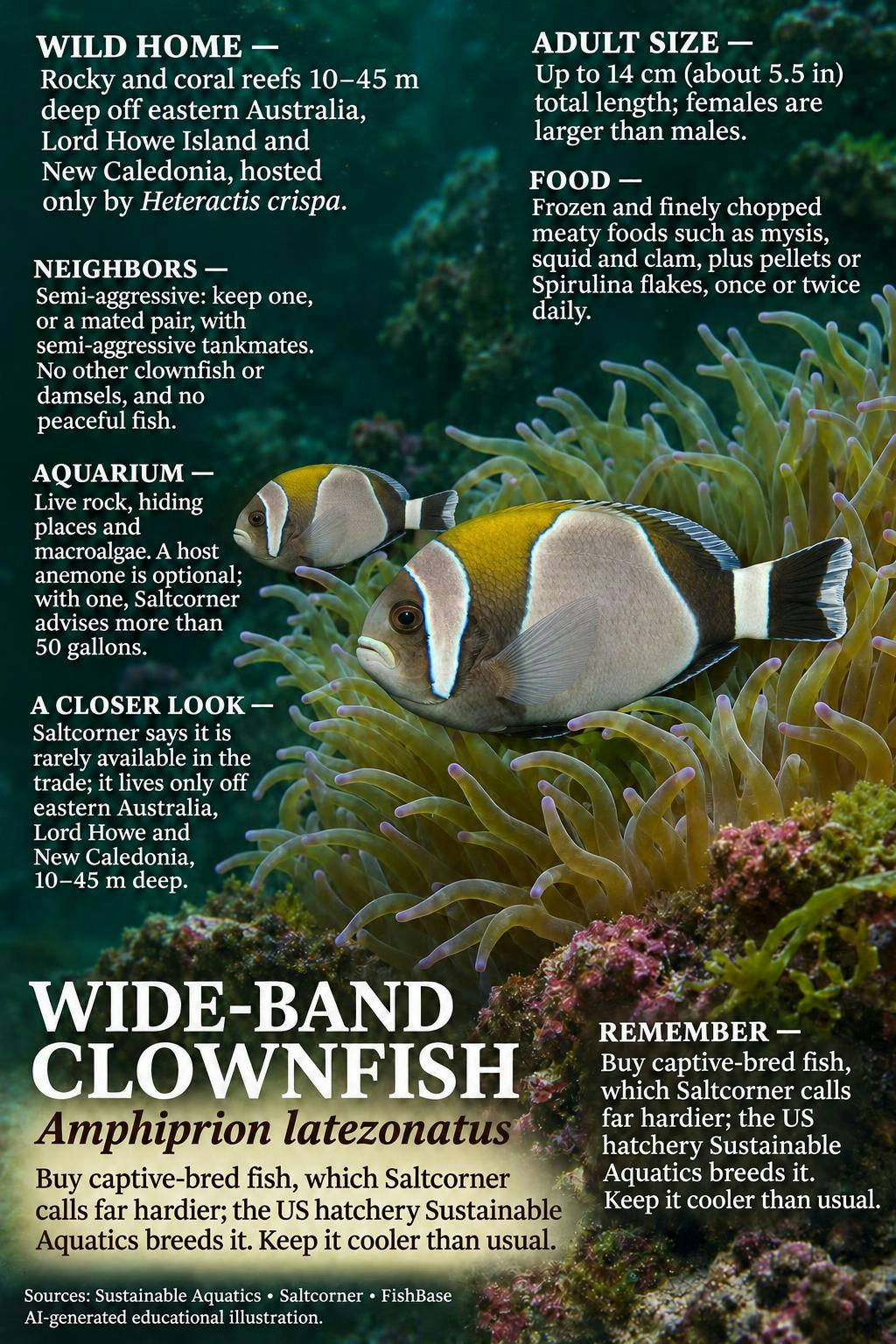
Read the infographic as text
- WILD HOME — Rocky and coral reefs 10–45 m deep off eastern Australia, Lord Howe Island and New Caledonia, hosted only by Heteractis crispa.
- ADULT SIZE — Up to 14 cm (about 5.5 in) total length; females are larger than males.
- FOOD — Frozen and finely chopped meaty foods such as mysis, squid and clam, plus pellets or Spirulina flakes, once or twice daily.
- NEIGHBORS — Semi-aggressive: keep one, or a mated pair, with semi-aggressive tankmates. No other clownfish or damsels, and no peaceful fish.
- AQUARIUM — Live rock, hiding places and macroalgae. A host anemone is optional; with one, Saltcorner advises more than 50 gallons.
- A CLOSER LOOK — Saltcorner says it is rarely available in the trade; it lives only off eastern Australia, Lord Howe and New Caledonia, 10–45 m deep.
- REMEMBER — Buy captive-bred fish, which Saltcorner calls far hardier; the US hatchery Sustainable Aquatics breeds it. Keep it cooler than usual.
How to use these figures
Published care ranges and suggested tank sizes are starting points, not guarantees. Tank footprint, group size, filtration, feeding, companions and the individual fish all matter. Standard length excludes the tail fin. Do not abruptly change established water conditions to match a number on a page.
Use a cycled aquarium, monitor water quality and quarantine new arrivals using a suitable species-specific plan. Persistent appetite loss, rapid breathing or weight loss warrants investigation.
Common questions
What should I know before choosing this fish?
Buy captive-bred fish, which Saltcorner calls far hardier; the US hatchery Sustainable Aquatics breeds it. Keep it cooler than usual. Semi-aggressive: keep one, or a mated pair, with semi-aggressive tankmates. No other clownfish or damsels, and no peaceful fish.
What should I feed it?
Frozen and finely chopped meaty foods such as mysis, squid and clam, plus pellets or Spirulina flakes, once or twice daily.
Why is it rare?
Saltcorner says it is rarely available in the trade; it lives only off eastern Australia, Lord Howe and New Caledonia, 10–45 m deep.
Sources & review
Checked November 12, 2026. Retailer care guidance is not a universal biological minimum.
- Sustainable Aquatics — SA Wide-Band Clownfish species information — reviewed care reference
- Saltcorner — Amphiprion latezonatus species page
- FishBase — Amphiprion latezonatus species account