
At a glance
- Adult size
- About 1.4 in body length
- Space
- 25 litres (7 US gallons) or more
- Social needs
- Keep a small group. Males guard spawning sites from rival males, and adults may eat eggs and fry.
Starting guidance, not a universal minimum. See the care details and sources below.
Adult size
FishBase gives a maximum standard length of 3.5 cm (about 1.4 inches). ANGFA says it usually does not exceed 40 mm and is most often 25–30 mm; AquaticCommunity gives 3 cm.
Aquarium space
AquaticCommunity says a 25 litre (about 7 US gallons) aquarium is large enough for a small group, provided the water quality is kept up.
Water conditions
AquaticCommunity recommends 72–86°F (22–30°C) and soft, acidic water, though it adapts to pH 7.5. ANGFA records wild pH 4.4–6.8 with very low dissolved minerals; FishBase gives dH 5–12. These are maintenance ranges, not targets to swing between; avoid abrupt changes.
Natural home
Still or slow, often tea-stained wallum swamps, creeks and dune lakes with dense plants in coastal southern Queensland, Australia.
Food and feeding
A varied diet of good dry food plus live foods such as brine shrimp and Daphnia, with plenty of live food for breeding.
Tankmates and behavior
Keep a small group. Males guard spawning sites from rival males, and adults may eat eggs and fry.
Setting up the habitat
Gentle flow and plenty of plants, including floating ones, for cover, with java moss or spawning mops for the eggs.
A closer look
FishBase lists it as Endangered: housing, forestry and farming have fragmented its range, and introduced mosquitofish are spreading.
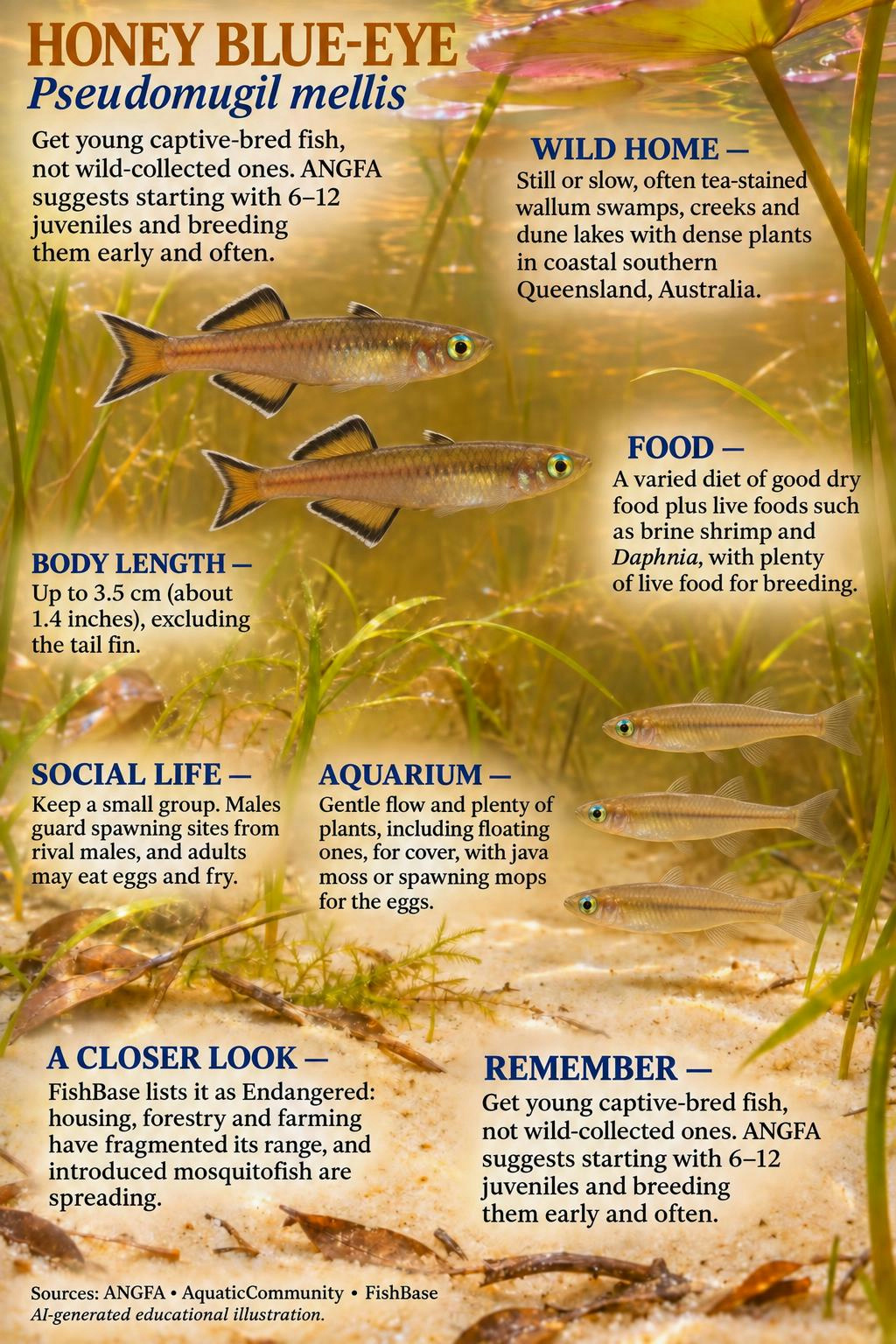
Read the infographic as text
- WILD HOME — Still or slow, often tea-stained wallum swamps, creeks and dune lakes with dense plants in coastal southern Queensland, Australia.
- BODY LENGTH — Up to 3.5 cm (about 1.4 inches), excluding the tail fin.
- FOOD — A varied diet of good dry food plus live foods such as brine shrimp and Daphnia, with plenty of live food for breeding.
- SOCIAL LIFE — Keep a small group. Males guard spawning sites from rival males, and adults may eat eggs and fry.
- AQUARIUM — Gentle flow and plenty of plants, including floating ones, for cover, with java moss or spawning mops for the eggs.
- A CLOSER LOOK — FishBase lists it as Endangered: housing, forestry and farming have fragmented its range, and introduced mosquitofish are spreading.
- REMEMBER — Get young captive-bred fish, not wild-collected ones. ANGFA suggests starting with 6–12 juveniles and breeding them early and often.
How to use these figures
Published care ranges and suggested tank sizes are starting points, not guarantees. Tank footprint, group size, filtration, feeding, companions and the individual fish all matter. Standard length excludes the tail fin. Do not abruptly change established water conditions to match a number on a page.
Use a cycled aquarium, monitor water quality and quarantine new arrivals using a suitable species-specific plan. Persistent appetite loss, rapid breathing or weight loss warrants investigation.
Common questions
What should I know before choosing this fish?
Get young captive-bred fish, not wild-collected ones. ANGFA suggests starting with 6–12 juveniles and breeding them early and often. Keep a small group. Males guard spawning sites from rival males, and adults may eat eggs and fry.
What should I feed it?
A varied diet of good dry food plus live foods such as brine shrimp and Daphnia, with plenty of live food for breeding.
Why is it rare?
FishBase lists it as Endangered: housing, forestry and farming have fragmented its range, and introduced mosquitofish are spreading.
Sources & review
Checked November 12, 2026. Retailer care guidance is not a universal biological minimum.