
At a glance
- Adult size
- About 15.9 cm (6.3 in) body length
- Space
- 375 litres (about 99 US gallons) or more
- Social needs
- The mildest damba, says Aquarist Atlas: territorial only when breeding. Raise six or more together; strange adults may kill each other.
Starting guidance, not a universal minimum. See the care details and sources below.
Adult size
FishBase gives a maximum standard length of 15.9 cm (about 6.3 inches), excluding the tail fin; Akvaforum gives 13 cm. Aquarist Atlas calls it the smallest damba and says hobby accounts give roughly 6–8 in total length.
Aquarium space
Akvaforum gives a minimum of 375 litres (about 99 US gallons). Aquarist Atlas says a pair or small group needs at least about 100 US gallons (379 litres), that a long footprint matters more than height, and recommends a standard tank of 125 US gallons (473 litres), 72 × 18 × 23 in. It calls this the first damba ever bred in captivity and the easiest of the genus to breed.
Water conditions
Akvaforum gives 24–28°C (75–82°F), pH 6–7 and 0–10 GH, and FishBase also gives 24–28°C. Aquarist Atlas prefers harder, more alkaline water, giving pH 6.5–8.5 and hardness up to 20°dH, and says to keep it warm, 75–86°F (24–30°C), as chronic low temperatures stress it. These are maintenance ranges, not targets to swing between; avoid abrupt changes.
Natural home
Shallow lakes and slow rivers of northwestern Madagascar, such as Lake Kinkony, over pebbles, sand and mud.
Food and feeding
Akvaforum says it prefers live and frozen food; Aquarist Atlas says it takes pellets and flake, plus snails and small shell-on shrimp.
Tankmates and behavior
The mildest damba, says Aquarist Atlas: territorial only when breeding. Raise six or more together; strange adults may kill each other.
Setting up the habitat
Siftable sand and smooth pebbles, driftwood, rocks and a cave, pot or tube for spawning; filter generously, as it is not waste-tolerant.
A closer look
Vulnerable (FishBase), hit by introduced tilapia and snakeheads; Aquarist Atlas says it is almost never a shop fish.
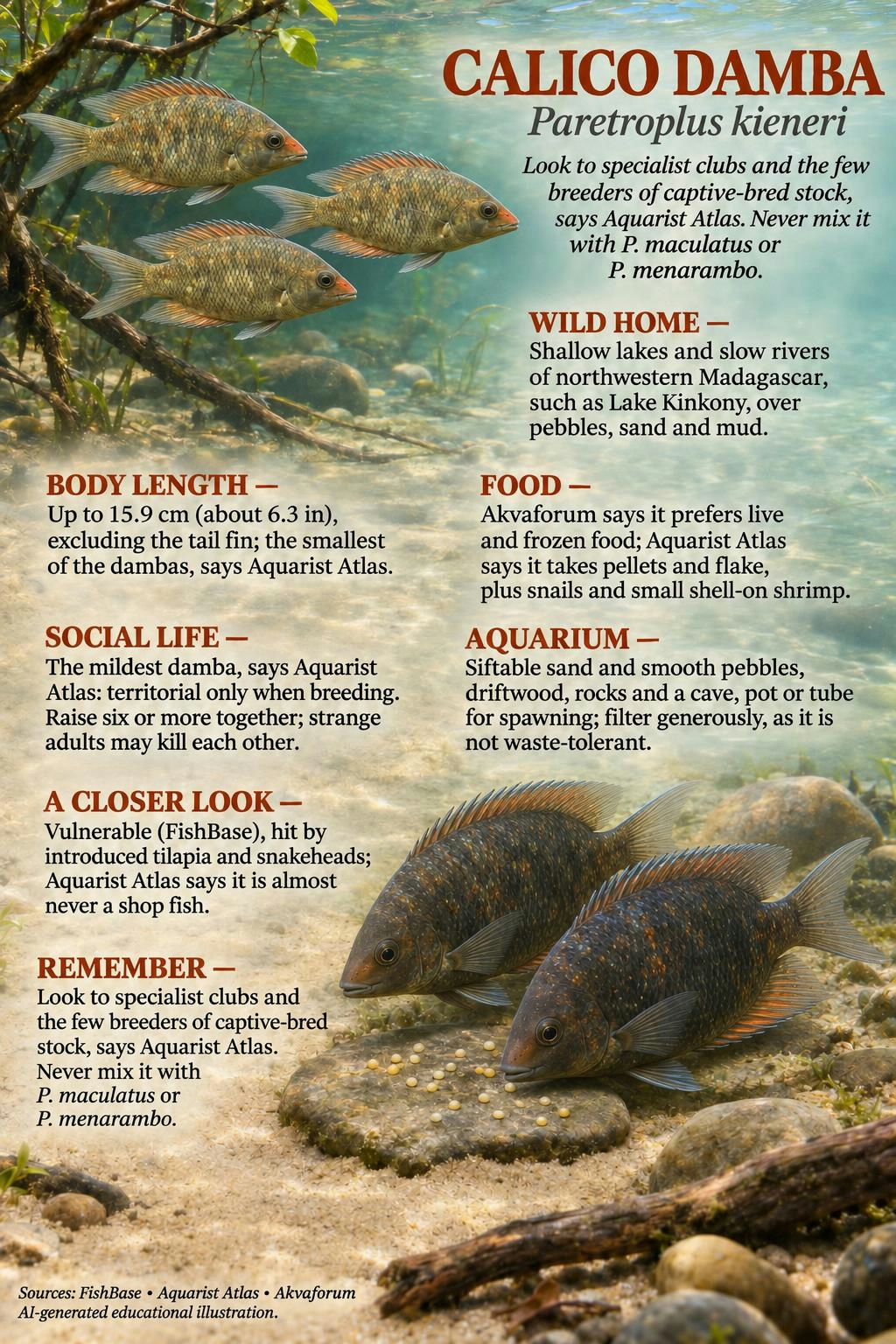
Read the infographic as text
- WILD HOME — Shallow lakes and slow rivers of northwestern Madagascar, such as Lake Kinkony, over pebbles, sand and mud.
- BODY LENGTH — Up to 15.9 cm (about 6.3 in), excluding the tail fin; the smallest of the dambas, says Aquarist Atlas.
- FOOD — Akvaforum says it prefers live and frozen food; Aquarist Atlas says it takes pellets and flake, plus snails and small shell-on shrimp.
- SOCIAL LIFE — The mildest damba, says Aquarist Atlas: territorial only when breeding. Raise six or more together; strange adults may kill each other.
- AQUARIUM — Siftable sand and smooth pebbles, driftwood, rocks and a cave, pot or tube for spawning; filter generously, as it is not waste-tolerant.
- A CLOSER LOOK — Vulnerable (FishBase), hit by introduced tilapia and snakeheads; Aquarist Atlas says it is almost never a shop fish.
- REMEMBER — Look to specialist clubs and the few breeders of captive-bred stock, says Aquarist Atlas. Never mix it with P. maculatus or P. menarambo.
How to use these figures
Published care ranges and suggested tank sizes are starting points, not guarantees. Tank footprint, group size, filtration, feeding, companions and the individual fish all matter. Standard length excludes the tail fin. Do not abruptly change established water conditions to match a number on a page.
Use a cycled aquarium, monitor water quality and quarantine new arrivals using a suitable species-specific plan. Persistent appetite loss, rapid breathing or weight loss warrants investigation.
Common questions
What should I know before choosing this fish?
Look to specialist clubs and the few breeders of captive-bred stock, says Aquarist Atlas. Never mix it with P. maculatus or P. menarambo. The mildest damba, says Aquarist Atlas: territorial only when breeding. Raise six or more together; strange adults may kill each other.
What should I feed it?
Akvaforum says it prefers live and frozen food; Aquarist Atlas says it takes pellets and flake, plus snails and small shell-on shrimp.
Why is it rare?
Vulnerable (FishBase), hit by introduced tilapia and snakeheads; Aquarist Atlas says it is almost never a shop fish.
Sources & review
Checked November 12, 2026. Retailer care guidance is not a universal biological minimum.