
At a glance
- Adult size
- About 7.5 in body length; 9.4 in total
- Space
- 160 cm long, 540 litres (about 143 US gallons)
- Social needs
- Large but peaceful; safe with placid fish such as small tetras and catfishes. Sexes look alike, so buy a group and let a pair form.
Starting guidance, not a universal minimum. See the care details and sources below.
Adult size
FishBase gives a maximum standard length of 19.0 cm (about 7.5 inches), excluding the tail fin, and 24 cm (about 9.4 inches) total length; Practical Fishkeeping gives 8 inches (20.3 cm), smaller than U. amphiacanthoides; the Nordiska Ciklidsällskapet register gives 25 cm.
Aquarium space
Only the Nordiska Ciklidsällskapet register gives a tank size: 160 cm (about 63.0 inches) long and 540 litres (about 143 US gallons). Practical Fishkeeping gives no tank size but advises a group in an unplanted aquarium.
Water conditions
It needs very warm water. The Nordiska Ciklidsällskapet register gives 28–32°C (82–90°F) and pH 5–7; FishBase gives 30–34°C (86–93°F) and pH from 5.0. Practical Fishkeeping says the wild water is soft, acidic blackwater, possibly pH 3–4, and that you need soft, acidic water to breed it. No source gives an aquarium hardness range. These are maintenance ranges, not targets to swing between; avoid abrupt changes.
Natural home
The Río Atabapo system on the Venezuela–Colombia border, in the Orinoco drainage: soft, acidic blackwater, where it is never abundant.
Food and feeding
Herbivorous: best fed a vegetable-based flake or pellet, plus occasional fresh or frozen foods; it accepts most foods.
Tankmates and behavior
Large but peaceful; safe with placid fish such as small tetras and catfishes. Sexes look alike, so buy a group and let a pair form.
Setting up the habitat
Use an unplanted tank, as it is not safe with plants. It is said to suffer from hole-in-the-head disease: watch it and treat promptly.
A closer look
Vulnerable and never abundant; few fish are exported from the remote border, which has little infrastructure for shipping.
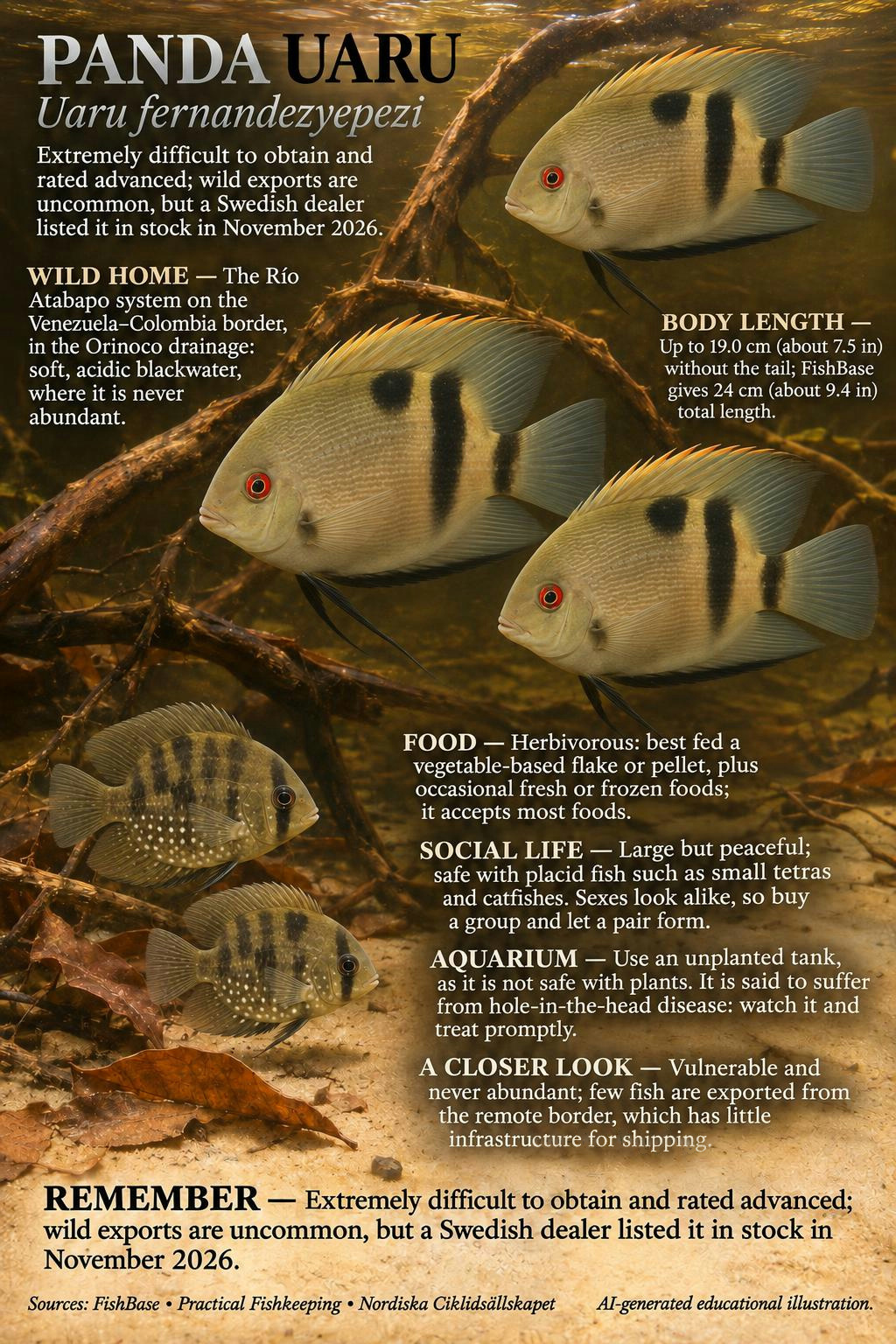
Read the infographic as text
- WILD HOME — The Río Atabapo system on the Venezuela–Colombia border, in the Orinoco drainage: soft, acidic blackwater, where it is never abundant.
- BODY LENGTH — Up to 19.0 cm (about 7.5 in) without the tail; FishBase gives 24 cm (about 9.4 in) total length.
- FOOD — Herbivorous: best fed a vegetable-based flake or pellet, plus occasional fresh or frozen foods; it accepts most foods.
- SOCIAL LIFE — Large but peaceful; safe with placid fish such as small tetras and catfishes. Sexes look alike, so buy a group and let a pair form.
- AQUARIUM — Use an unplanted tank, as it is not safe with plants. It is said to suffer from hole-in-the-head disease: watch it and treat promptly.
- A CLOSER LOOK — Vulnerable and never abundant; few fish are exported from the remote border, which has little infrastructure for shipping.
- REMEMBER — Extremely difficult to obtain and rated advanced; wild exports are uncommon, but a Swedish dealer listed it in stock in November 2026.
How to use these figures
Published care ranges and suggested tank sizes are starting points, not guarantees. Tank footprint, group size, filtration, feeding, companions and the individual fish all matter. Standard length excludes the tail fin. Do not abruptly change established water conditions to match a number on a page.
Use a cycled aquarium, monitor water quality and quarantine new arrivals using a suitable species-specific plan. Persistent appetite loss, rapid breathing or weight loss warrants investigation.
Common questions
What should I know before choosing this fish?
Extremely difficult to obtain and rated advanced; wild exports are uncommon, but a Swedish dealer listed it in stock in November 2026. Large but peaceful; safe with placid fish such as small tetras and catfishes. Sexes look alike, so buy a group and let a pair form.
What should I feed it?
Herbivorous: best fed a vegetable-based flake or pellet, plus occasional fresh or frozen foods; it accepts most foods.
Why is it rare?
Vulnerable and never abundant; few fish are exported from the remote border, which has little infrastructure for shipping.
Sources & review
Checked November 12, 2026. Retailer care guidance is not a universal biological minimum.