
At a glance
- Adult size
- About 2 in body length; aquarium males 4 in or more
- Space
- 40-gallon breeder or larger for a group of 6–8
- Social needs
- Tiny but pugnacious: keep 6–8 rather than a pair, as males turn on females. Tankmates must handle aggression yet be too small to eat it.
Starting guidance, not a universal minimum. See the care details and sources below.
Adult size
FishBase gives a maximum standard length of 5.0 cm (about 2.0 inches), excluding the tail fin, and Borstein gives 2 inches for wild males. Aquarium fish grow larger: Borstein says overfed fish reach 4 inches (10.2 cm), and Practical Fishkeeping’s largest male neared 12 cm (about 4.7 inches). Males are larger than females.
Aquarium space
Borstein keeps groups of 6–8, not pairs, in a tank no smaller than a 40-gallon breeder, 40 US gallons (151 litres). Practical Fishkeeping kept five fish in 900 litres (about 238 US gallons) and says a pair put in a small tank ended with the male killing the female, so give each pair a lot of room.
Water conditions
No source gives a temperature range; FishBase only calls it tropical. Practical Fishkeeping says Lake Bermin is slightly alkaline, around pH 7.5, but fairly soft (80 microsiemens), and Borstein says it is very hardy and copes with many types of water. No source gives an aquarium hardness figure. These are maintenance ranges, not targets to swing between; avoid abrupt changes.
Natural home
Only Lake Bermin, a tiny crater lake atop a volcano in southwest Cameroon, ringed by jungle and littered with leaves and logs.
Food and feeding
Exceptionally herbivorous: spirulina flake and small granules suit. It strips most plants to the stems and eats hair algae.
Tankmates and behavior
Tiny but pugnacious: keep 6–8 rather than a pair, as males turn on females. Tankmates must handle aggression yet be too small to eat it.
Setting up the habitat
No live plants. Wood, rocks and a sand bottom with shady spots, plus caves with small openings; pairs guard fry for months.
A closer look
Critically Endangered: the whole wild population is tiny, in one crater lake whose surroundings are at risk from deforestation.
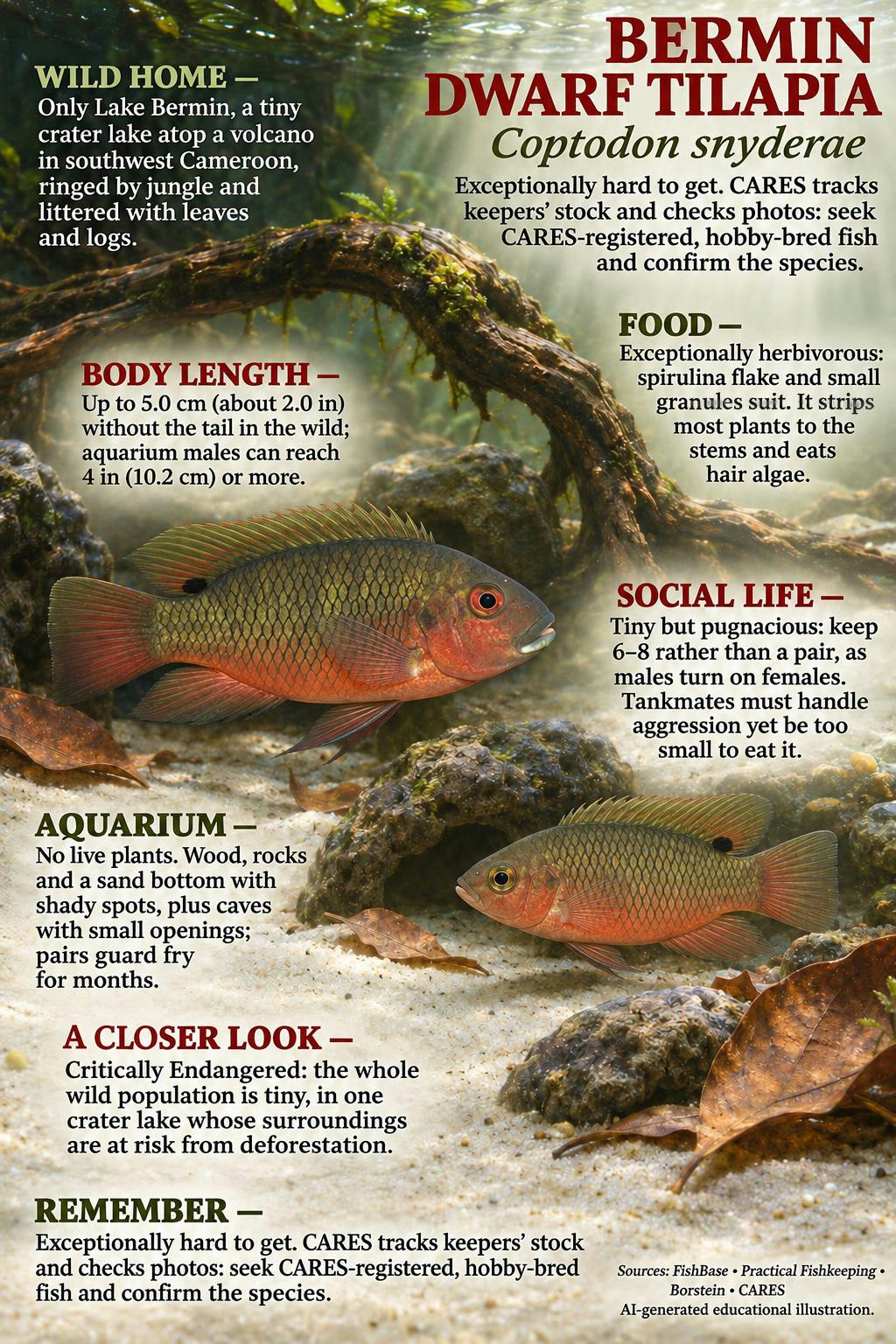
Read the infographic as text
- WILD HOME — Only Lake Bermin, a tiny crater lake atop a volcano in southwest Cameroon, ringed by jungle and littered with leaves and logs.
- BODY LENGTH — Up to 5.0 cm (about 2.0 in) without the tail in the wild; aquarium males can reach 4 in (10.2 cm) or more.
- FOOD — Exceptionally herbivorous: spirulina flake and small granules suit. It strips most plants to the stems and eats hair algae.
- SOCIAL LIFE — Tiny but pugnacious: keep 6–8 rather than a pair, as males turn on females. Tankmates must handle aggression yet be too small to eat it.
- AQUARIUM — No live plants. Wood, rocks and a sand bottom with shady spots, plus caves with small openings; pairs guard fry for months.
- A CLOSER LOOK — Critically Endangered: the whole wild population is tiny, in one crater lake whose surroundings are at risk from deforestation.
- REMEMBER — Exceptionally hard to get. CARES tracks keepers’ stock and checks photos: seek CARES-registered, hobby-bred fish and confirm the species.
How to use these figures
Published care ranges and suggested tank sizes are starting points, not guarantees. Tank footprint, group size, filtration, feeding, companions and the individual fish all matter. Standard length excludes the tail fin. Do not abruptly change established water conditions to match a number on a page.
Use a cycled aquarium, monitor water quality and quarantine new arrivals using a suitable species-specific plan. Persistent appetite loss, rapid breathing or weight loss warrants investigation.
Common questions
What should I know before choosing this fish?
Exceptionally hard to get. CARES tracks keepers’ stock and checks photos: seek CARES-registered, hobby-bred fish and confirm the species. Tiny but pugnacious: keep 6–8 rather than a pair, as males turn on females. Tankmates must handle aggression yet be too small to eat it.
What should I feed it?
Exceptionally herbivorous: spirulina flake and small granules suit. It strips most plants to the stems and eats hair algae.
Why is it rare?
Critically Endangered: the whole wild population is tiny, in one crater lake whose surroundings are at risk from deforestation.
Sources & review
Checked November 12, 2026. Retailer care guidance is not a universal biological minimum.