
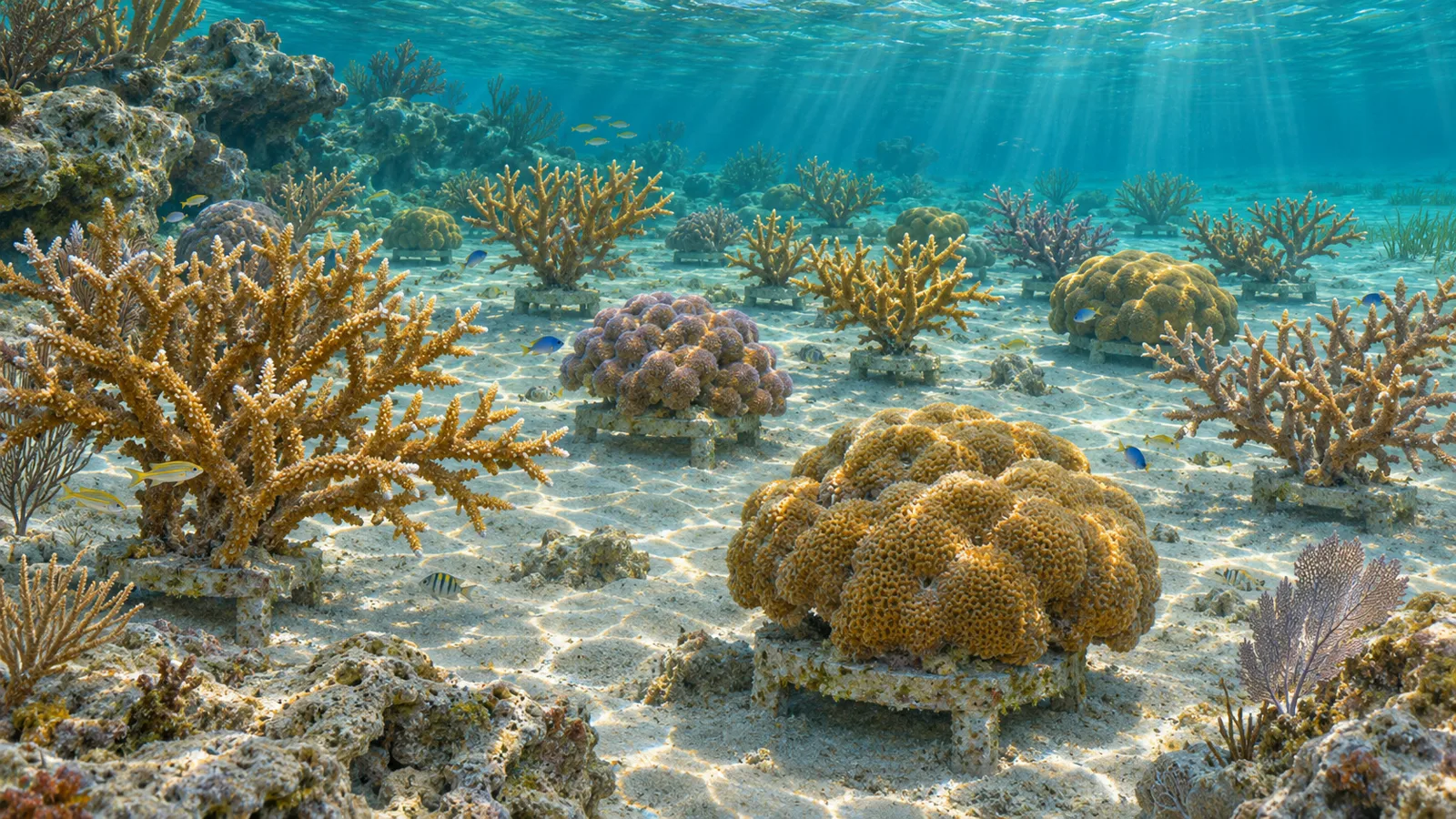
Florida Atlantic University researchers will test 100 coral genotypes from five reef-building species at nine Florida reef sites to find out whether genetics, microbial partners and local conditions can predict survival after transplanting. The university announced nearly $1.25 million in combined federal and state funding on November 4. This is a newly funded research programme, not a report that the team has already solved coral restoration.1
The same coral lineage will face different reef conditions
The four-year, $997,858 Environmental Protection Agency project runs through 2030, with sites in the Upper Keys, Lower Keys and Broward County. Steven Vollmer, director of FAU’s School of Environmental, Coastal, and Ocean Sustainability, and biological sciences researcher Carsten Grupstra lead the complementary projects. Their team will ask whether corals identified as heat-tolerant during the 2023 bleaching event retain that advantage across different reef environments. Strong performers will be replanted in later years to test whether choosing genotypes improves restoration outcomes.1
A genotype is a genetic identity, not a species. Growing many fragments from one colony can increase the number of corals available without providing the same variety as many genetically different colonies. The study’s combination of 100 genotypes and five species therefore describes two different kinds of diversity. Its central question is whether a promising genetic identity performs consistently when the environment changes.1
Survival, growth, bleaching and disease will be tracked
A second grant, $244,962 from the Florida Department of Environmental Protection, supports a one-year project launched in July. It establishes experimental coral gardens and the initial genetic and microbial baseline. Field monitoring, genome sequencing and analyses of coral-associated algae and bacteria will help the researchers look for traits linked to survival, growth, bleaching and disease. Reef Renewal USA will provide nursery infrastructure and field support; Broward County’s Resilience Office will use performance data in reef planning.1
The need is practical. FAU reports that first-year mortality has exceeded 90 percent for some coral species at certain restoration sites. That figure is site- and species-dependent, not an estimate for all restored corals. The team wants evidence for matching coral stock to a destination, rather than assuming that producing and planting more fragments will produce a lasting reef.1
What reef keepers can take from the question
For a home reef keeper, the useful distinction is between keeping a coral alive in cultivation and demonstrating that it can thrive after a move. The FAU announcement provides no aquarium temperature target, bacterial additive recommendation or shopping list of heat-proof corals. Those would outrun the evidence. Its relevance is the test itself: an animal’s inherited traits and microbial partners are being examined together with the environment it actually experiences.1
NOAA’s existing Mission: Iconic Reefs programme supplies the broader context. Its approach combines coral planting with site preparation, maintaining coral diversity, monitoring and ongoing care. NOAA also describes adding algae-eating animals and removing competitors as parts of ecosystem restoration. That background explains why a coral-only survival test cannot stand in for the whole reef: successful restoration also depends on what surrounds the transplanted colony. The newly announced FAU work aims to make one important choice, which coral to plant where, more evidence-based.2
Sources and notes 2 references
- Florida Atlantic University — FAU Awarded $1.2M to Advance Coral Reef Restoration in Florida (opens in a new tab)November 4, 2026; research announcement, not completed results
- NOAA Fisheries — Restoring Seven Iconic Reefs (opens in a new tab)Undated programme background; accessed November 12, 2026
Background: November 4, 2026 (FAU research announcement). Published November 12, 2026.
Research and reporting dates are kept as published, and older work isn’t presented as news. Product claims are attributed to their makers. Photos are illustrative and don’t show store stock.