
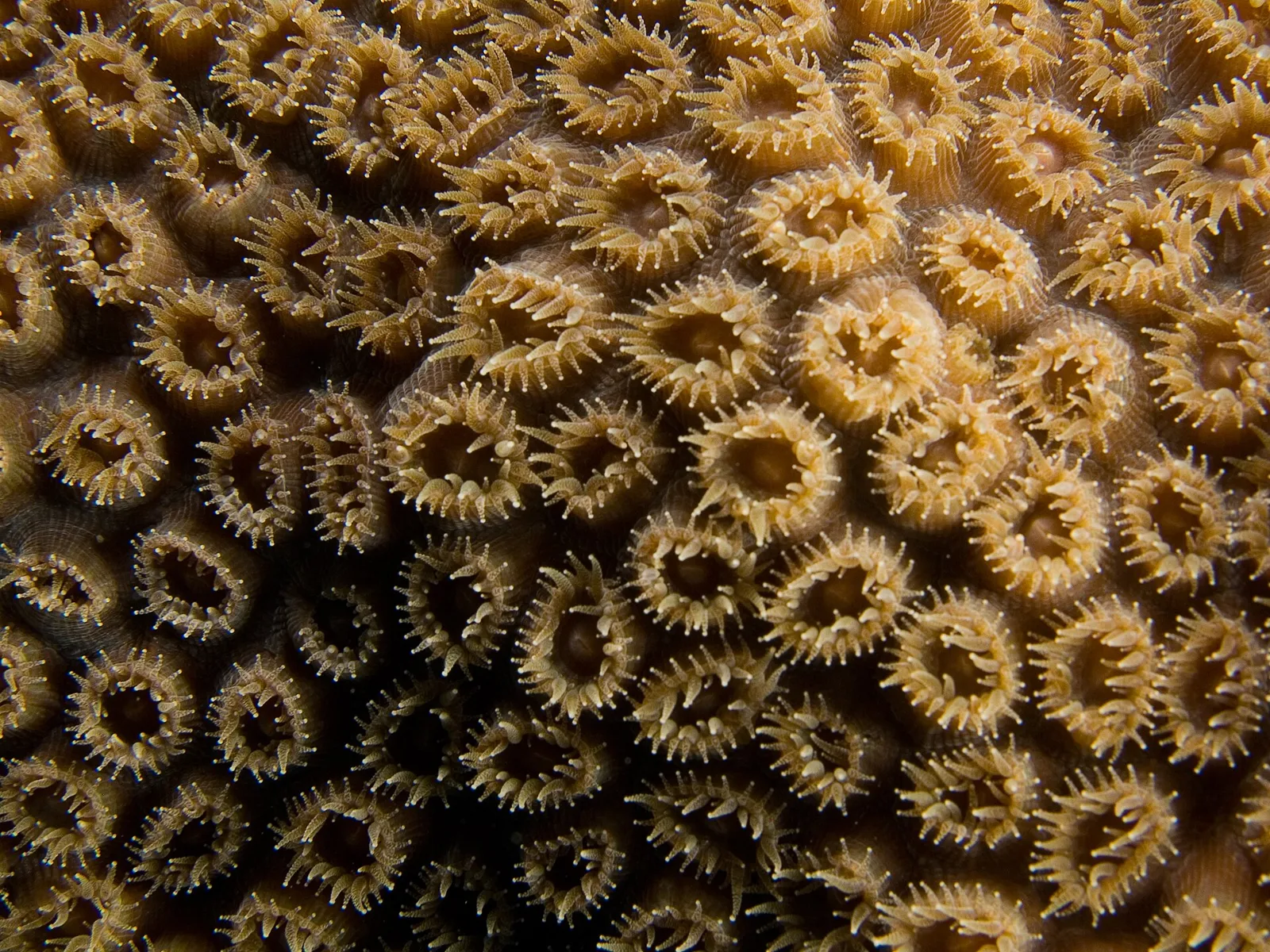
Young reef-building corals responded differently to the colour of their light in a four-nursery experiment: one species grew best under a reef-like spectrum, another under a more strongly blue-shifted spectrum. The study, listed in the October 2026 issue of Aquaculture, offers reef keepers a useful reason to be cautious about a single lighting recipe. This is earlier research, with a June 2026 online publication indicated in the paper’s metadata, rather than a newly announced November result.1
Three species under three spectra
Liam A. Abrams and colleagues studied Colpophyllia natans, Pseudodiploria strigosa and Montastraea cavernosa during their early grow-out, following survival and growth up to seven months of age. Four land-based nurseries ran the experiment concurrently using the same larval cohorts, allowing the team to compare related groups of young corals across facilities.1
The treatments represented near-surface sunlight typical of outdoor grow-out tanks, a reef-mimic spectrum produced by LED aquarium fixtures to resemble light at about 33 feet (10 metres), and a blue-shifted LED spectrum peaking between 400 and 450 nanometres. All treatments began at the same photon flux, 25 micromoles of photons per square metre per second, and increased gradually to 200 by day 133. Those matched increases matter: the comparison concerned spectral composition under a shared light-intensity schedule.1
Growth changed more than survival
Survival was comparable among the spectra, while artificial lighting promoted more growth than the near-surface sunlight treatment. Colpophyllia natans grew up to twice as large under reef-mimic light, and Montastraea cavernosa up to five times as large under blue-shifted light. Pseudodiploria strigosa performed similarly under the two artificial spectra. These are reported experimental comparisons, not promised growth multipliers for aquarium colonies.1
Corals in the near-surface spectrum also reached full pigmentation later than those under artificial lighting. The researchers report that differences in algal symbionts did not appear to explain the species-specific spectral responses.1
What a reef keeper can take from it
NOAA explains that photosynthetic algae living within coral tissues supply materials the host uses for growth and reproduction, and also contribute to coral colour. Light therefore affects a living partnership inside the animal, beyond how a colony looks to its keeper.2
The experiment supports comparing lighting needs at the species level. Its scope is young, sexually produced Caribbean corals raised for restoration; it does not establish an ideal spectrum for every adult coral, mixed reef or aquarium fixture. The abstract provides no transferable channel-percentage recipe for a home tank. Species identity and life stage remain essential context when interpreting these results.1
Sources and notes 2 references
- Abrams and colleagues: Species-specific light spectrum optimization for coral grow-out, university abstract and publication record (opens in a new tab)October 15, 2026 issue record; earlier online publication June 2026; abstract read
- NOAA: Corals and zooxanthellae (opens in a new tab)Undated educational background; accessed November 16, 2026
Background: Earlier research: June 2026 online; October 2026 journal issue. Published November 16, 2026.
Research and reporting dates are kept as published, and older work isn’t presented as news. Product claims are attributed to their makers. Photos are illustrative and don’t show store stock.