
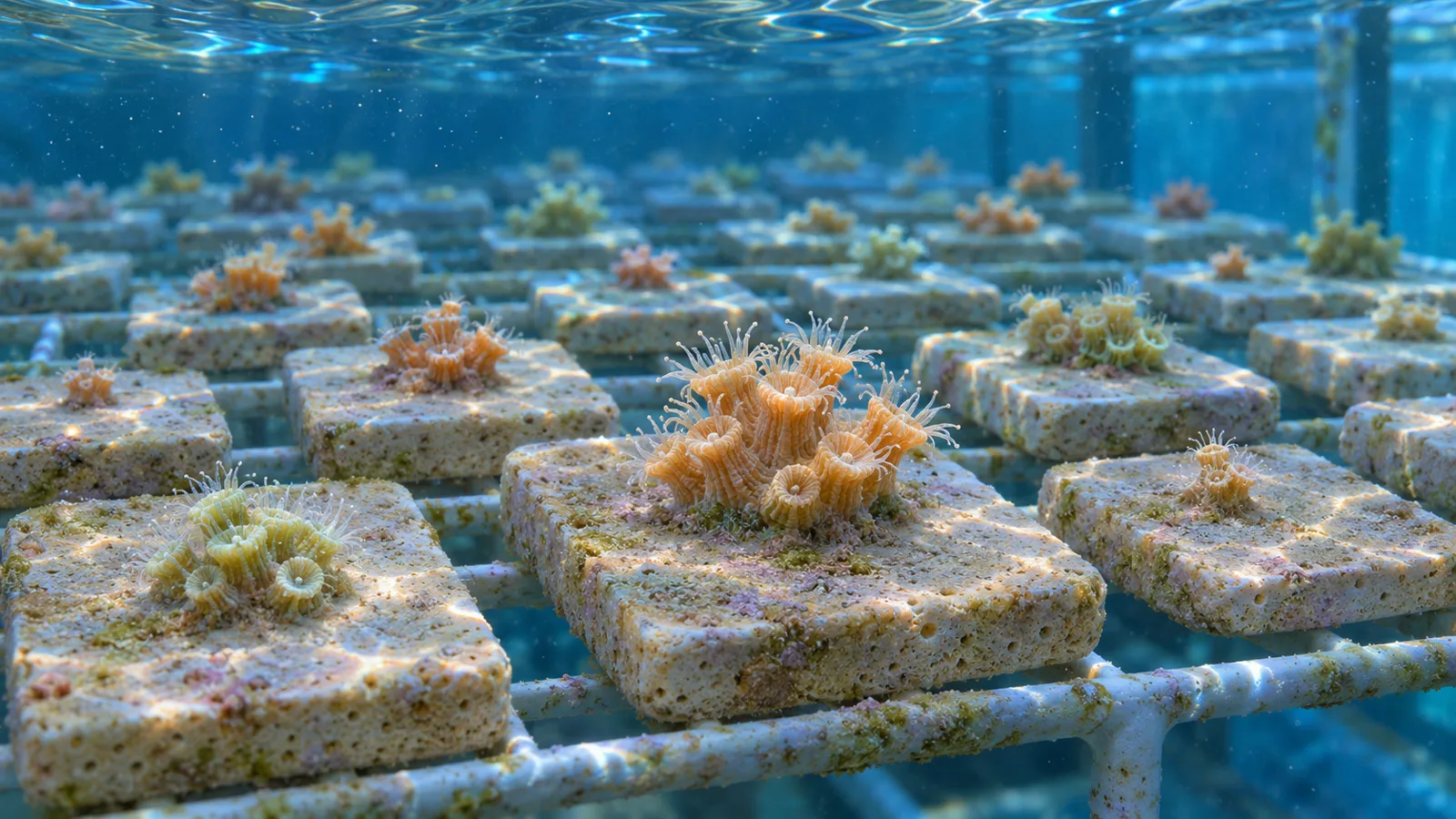
More than 4,500 juvenile corals are being nurtured at a new indoor nursery at The Chinese University of Hong Kong. The university opened its Coral Academy Hub on October 24, describing it as Hong Kong’s first and only indoor nursery dedicated to raising young corals through sexual propagation, or assisted coral reproduction. For reef aquarists interested in breeding corals, the development is a sizeable new base for work on animals produced through reproduction rather than simply expanding a collection of fragments.1
A permanent home for coral breeding
The hub is the first physical base for the Coral Academy, which Professor Apple Chui Pui-yi founded in 2018. Chui is an assistant professor in the university’s School of Life Sciences. The facility combines its indoor nursery with an outdoor space for workshops and public engagement. CUHK says it will support coral cultivation, environmental education and community participation in restoration in Hong Kong and the wider Guangdong-Hong Kong-Macao Greater Bay Area.1
The nursery also links research with an existing school programme. Co-developed with Hong Kong’s Agriculture, Fisheries and Conservation Department in 2019, the In-School Coral Nursery Education Programme enables primary and secondary students to raise corals in campus aquariums. The university says the new hub will also expand citizen-science opportunities with the department. These are organised education and conservation activities; the announcement does not offer corals for home aquariums or provide a home breeding protocol.1
Breeding corals adds genetic variety
NOAA describes coral restoration as including both gardening and outplanting existing corals and collecting naturally produced eggs and sperm to create new genetic individuals. That distinction explains the interest in a nursery dedicated to sexual propagation. Producing many fragments can expand the number of colonies, while breeding can add genetic variety. NOAA also stresses improving habitat quality, coral health and survival alongside growing nursery stock: cultivation is one part of restoration, not evidence that a reef has recovered.2
CUHK’s figure is a count of juveniles currently in care, not a claim that 4,500 corals have survived transplantation onto reefs. The announcement provides no species-by-species survival results, lighting settings or feeding schedules. Its concrete news is the opening of a dedicated breeding nursery and learning space, with thousands of young corals already being nurtured there. Reef keepers can follow the programme for future husbandry findings without treating the opening announcement as a tested recipe for their own tanks.1
Sources and notes 2 references
- CUHK — Coral Academy Hub launch and juvenile coral nursery (opens in a new tab)October 24, 2026
- NOAA Fisheries — Restoring Coral Reefs (opens in a new tab)Undated background; accessed November 14, 2026
Background: October 24, 2026 (CUHK announcement). Published November 14, 2026.
Research and reporting dates are kept as published, and older work isn’t presented as news. Product claims are attributed to their makers. Photos are illustrative and don’t show store stock.