
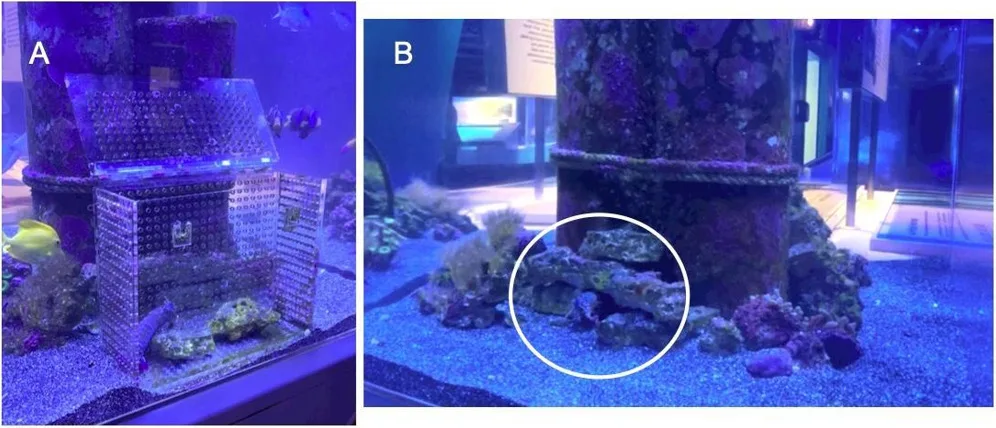
A peacock mantis shrimp learned to approach a feeding target at Miami’s Phillip and Patricia Frost Museum of Science, according to a case study published October 31 in JZAR. The adult female, Odontodactylus scyllarus, learned the orienting and positioning behaviours within three months. Completing the entire nine-stage training plan took 224 calendar days. The observations were made in 2022–2024; the new development is their publication.1
A feeding cue learned gradually
The shrimp arrived on October 15, 2022, and initially lived inside a perforated acrylic holding container within a larger exhibit. Aquarists gradually paired the target with food, then changed where it appeared and how long the animal waited for its reward. Training and feeding took place five days a week under the museum’s animal-care plan. These were that institution’s procedures, not a feeding schedule tested for home aquariums.1
The team used videos to measure how long the shrimp took to look toward and approach the target. Early responses were variable. In stages four through nine, it oriented within an average of ten seconds in 56 of 59 recorded sessions and positioned itself within that time in 50 of 59. It retained the behaviours after leaving the holding container on April 19, 2023, and completed the plan on May 27.1
Shared housing remains an open question
The exhibit contained about 15 fish from eight species. The authors report no aggression toward tankmates during more than nine months after release, until the shrimp died following a failed molt in January 2024. However, aggression was not measured systematically, and there was no comparison group. A supplied hiding place, rocks and barnacles may also have reduced defensive behaviour. One animal’s history cannot establish that training prevents predation or makes a mixed home tank safe.1
For hobbyists, the useful result is evidence of learning and retained feeding responses in an aquarium invertebrate. The National Aquarium describes target training as rewarding an animal for responding to a chosen object. Its own programmes adapt the target and pace to each animal, including a map pufferfish that initially preferred afternoon sessions. That background helps explain why a successful training plan is individual, rather than a fixed timetable.2
The Frost team hopes other aquariums will test whether its experience holds for more mantis shrimp. That would help separate a repeatable training result from the still-unanswered question of whether training reduces aggression.1
Sources and notes 2 references
- Maroon et al. — Mantis shrimp target training for coexistence in a multi-species habitat (opens in a new tab)October 31, 2026; observations October 2022–January 2024; full paper read
- National Aquarium — Keeping It Positive: Target Training (opens in a new tab)May 15, 2025; background on training, not the new study
Background: October 31, 2026. Published November 10, 2026.
Research and reporting dates are kept as published, and older work isn’t presented as news. Product claims are attributed to their makers. Photos are illustrative and don’t show store stock.