
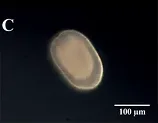
A field-friendly freezing method kept larvae of two mushroom coral species swimming 24 hours after thawing, but it did not work reliably across the other corals tested. The November 10 study in Advanced Science gives coral breeders a clearer account of where cryomesh preservation succeeds and where it still fails. Swimming after thawing, the authors stress, is a different result from settling and growing into a young coral.1
Two species survived the first day
E. Michael Henley, Jonathan Daly and colleagues examined larvae from Pacific and Caribbean corals, working with institutions including the Smithsonian, Taronga, the Australian Institute of Marine Science and The Florida Aquarium. Cryomesh uses metal mesh to move heat rapidly away from samples. Protective chemicals help the sample form an ice-free glass, a process called vitrification; rapid warming must also avoid damaging ice crystals.1
The clearest 24-hour swimming results came from Lobactis scutaria and Fungia fungites. Both had very small larvae without algal partners. Yet small size alone was insufficient: Pocillopora meandrina larvae could vitrify without surviving to the next day. Chemical toxicity, how readily protective solutions entered tissues, developmental age and husbandry all remained possible constraints.1
Smaller larvae did not solve every problem
The team also separated some early embryos into smaller pieces to shorten the distance heat must travel. These reduced-size larvae did not swim after thawing. Crucially, unfrozen controls produced by the same separation could settle and mature normally. The manipulation itself therefore did not prevent development, but it did not establish a successful freezing method either.1
Some surviving larvae fractured during preservation, complicating survival counts. The researchers call for better tests of protective chemicals and their movement into tissues, followed by measurements of settlement and continued growth. A moving fragment is not yet evidence of a restoration-ready coral.1
Banking larvae could loosen the spawning calendar
The longer-term goal predates this paper. In October 2018, Smithsonian researchers reported freezing and thawing mushroom coral larvae using gold nanorods and an infrared laser. Their announcement explained why banking larvae matters: conservationists could potentially use stored early-life material outside the short natural spawning season. That earlier laser-based work is background, not a new result from the cryomesh study.2
For reef keepers following captive propagation, the new work identifies specific biological hurdles between a preserved larva and a growing colony. It does not demonstrate a universal coral-banking recipe or a home-aquarium technique.1
Sources and notes 2 references
- Henley, Daly and colleagues — Steps Toward Vitrification and Banking of Coral Larvae Using Field-Friendly Cryomesh Technology (opens in a new tab)November 10, 2026
- Smithsonian — Scientists Freeze and Thaw Coral Larvae for the First Time (historical background) (opens in a new tab)October 24, 2018
Background: November 10, 2026 (paper); October 24, 2018 (background). Published November 20, 2026.
Research and reporting dates are kept as published, and older work isn’t presented as news. Product claims are attributed to their makers. Photos are illustrative and don’t show store stock.