
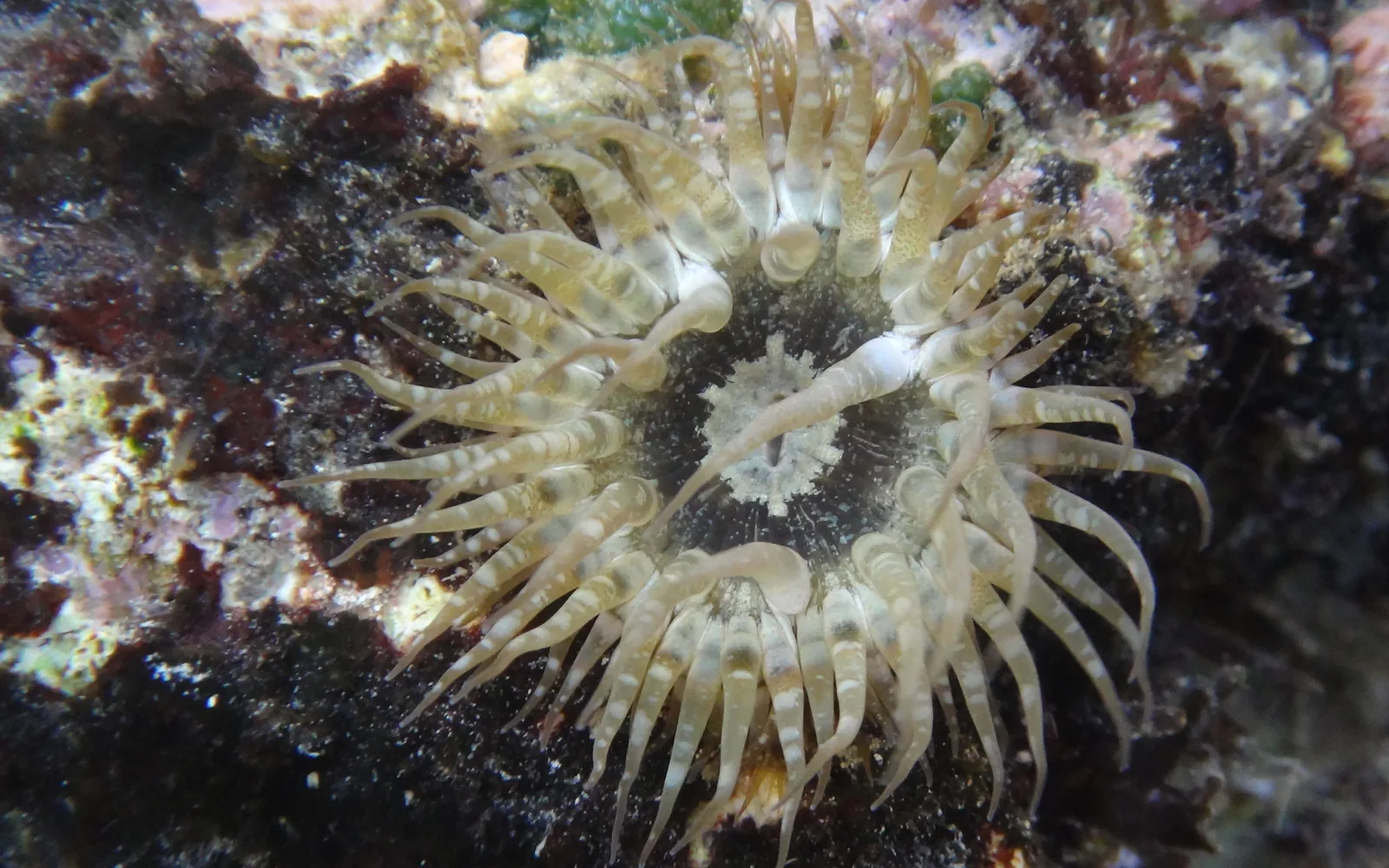
Algae and bacteria work together to help Aiptasia sea anemones turn available nitrogen into essential amino acids, according to research published November 2 in Nature Communications. The experiments reveal a nutritional partnership involving three participants, rather than just the familiar animal and its photosynthetic algae. The work used anemones as a model for studying coral biology; it was not a trial in reef-building corals.1
The team, co-led by Guoxin Cui at The Chinese University of Hong Kong and Manuel Aranda at King Abdullah University of Science and Technology, looked inside the animal’s tissues. With a laser, researchers separated the inner tissue layer, where symbiotic algae live, from the outer layer. Sequencing RNA then helped them identify microbes and determine which microbial genes were active, rather than simply recording which bacteria were present.2
That distinction matters because an animal’s tissues are not one uniform microbial habitat. In anemones containing algae, bacterial activity changed especially strongly in the inner layer. Nine of twelve nitrite-reductase genes examined were significantly more active there. These mostly bacterial genes encode enzymes that convert nitrite into ammonium, a form of nitrogen that can be used to make amino acids and other biological molecules.1
To follow nitrogen through the partnership, the researchers supplied nitrite containing the stable isotope nitrogen-15. This label let them track its incorporation into amino acids. They compared animals with and without algae, and also compared normal bacterial communities with communities depleted using antibiotics. That design helped separate the contributions of the algae and bacteria.1
With bacteria suppressed, algae-bearing anemones incorporated 7.8 times as much labelled nitrogen as their algae-free counterparts. With the natural bacterial communities retained, the corresponding difference was 12.7-fold. These are comparisons within the experimental groups, not estimates of how much faster aquarium animals grow. Four of eight essential amino acids showed nitrogen incorporation beyond the combined independent contributions of the two microbial partners.2
Cui suggests that photosynthetic sugars could supply energy for bacterial nitrogen conversion. The university describes plans to extend the approach to reef-building corals and examine responses to warming and nutrient pollution. Losing algae during bleaching could therefore disrupt more than the animal’s supply of photosynthetic energy; it may also disturb microbial nutrient processing linked to that partnership.2
For reef keepers, the useful finding is a more detailed explanation of symbiosis, not a new dosing recipe. This study does not establish a nitrite target, test a bottled bacterial supplement or demonstrate a treatment for bleached aquarium corals. Its strength is showing how tissue location, algal presence and bacterial metabolism can jointly shape an animal’s nutrition.1
Sources and notes 2 references
- Cui et al. — Algal symbiosis adaptively restructures the cnidarian microbiome to enhance holobiont metabolism (opens in a new tab)Published November 2, 2026
- CUHK — Algae-bacteria synergy in anemone nutrition (opens in a new tab)November 4, 2026
Background: November 2, 2026 (Nature Communications); November 4, 2026 (CUHK). Published November 4, 2026.
Research and reporting dates are kept as published, and older work isn’t presented as news. Product claims are attributed to their makers. Photos are illustrative and don’t show store stock.