
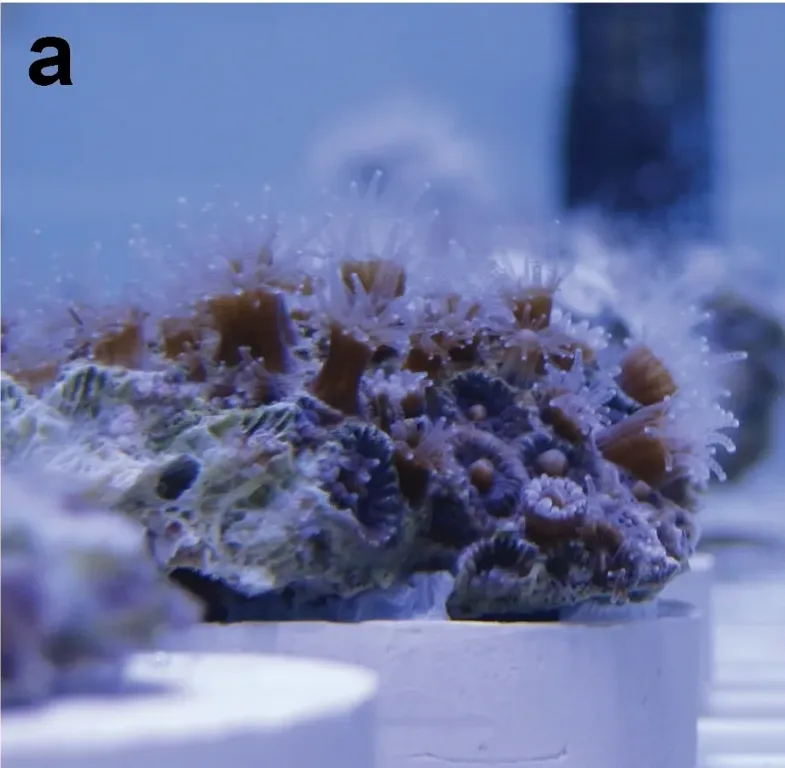
Researchers can reliably trigger spawning and rear larvae of the northern star coral, Astrangia poculata, using methods developed across a decade of laboratory work. Published August 28 in Frontiers in Marine Science and highlighted by Roger Williams University in September, the study reports fertilization rates of 70% to 93% and a chemical cue that helped larvae attach and become young polyps.1
This small, hard coral offers an unusual research advantage: it naturally lives with widely varying amounts of photosynthetic algae. Scientists can compare animals with many algae and animals with very few without first imposing the heat or light stress often used to bleach tropical corals. That helps separate the effects of the algae from the effects of the stress treatment itself.1
The collaboration, led by Koty Sharp at Roger Williams University, brought researchers together for annual summer sessions called Spawnfest. Teams collected corals by SCUBA in Rhode Island and refined methods for controlled breeding. The university describes the work as a foundation for investigating coral resilience and animal-microbe relationships.2
In the paper, warming recently collected colonies induced eggs and sperm to be released on a predictable schedule. Some colonies spawned on four consecutive days. Feeding larvae with either of two commercial coral foods was associated with survival for up to 40 days; unfed larvae did not survive beyond 12 days. Those observations concern laboratory cultures, not a tested feeding prescription for a home reef.1
Getting larvae to settle remained a separate hurdle. At the lower concentration tested, tetrabromopyrrole, a small chemical molecule, produced about 53% settlement. The higher concentration reduced survival compared with seawater controls. These methods support experiments on early coral life and symbiosis; they do not demonstrate heat-resistant tropical corals or a treatment for aquarium bleaching.1
Sources and notes 2 references
- Borbee et al. — Development of methods for spawning, fertilization, larval husbandry, and settlement in the temperate coral Astrangia poculata (opens in a new tab)Published August 28, 2026
- Roger Williams University — Research establishes new model organism for coral science (opens in a new tab)September 8, 2026; date confirmed by URI republication October 7, 2026
Background: August 28, 2026 (paper); September 8, 2026 (RWU announcement). Published November 5, 2026.
Research and reporting dates are kept as published, and older work isn’t presented as news. Product claims are attributed to their makers. Photos are illustrative and don’t show store stock.