
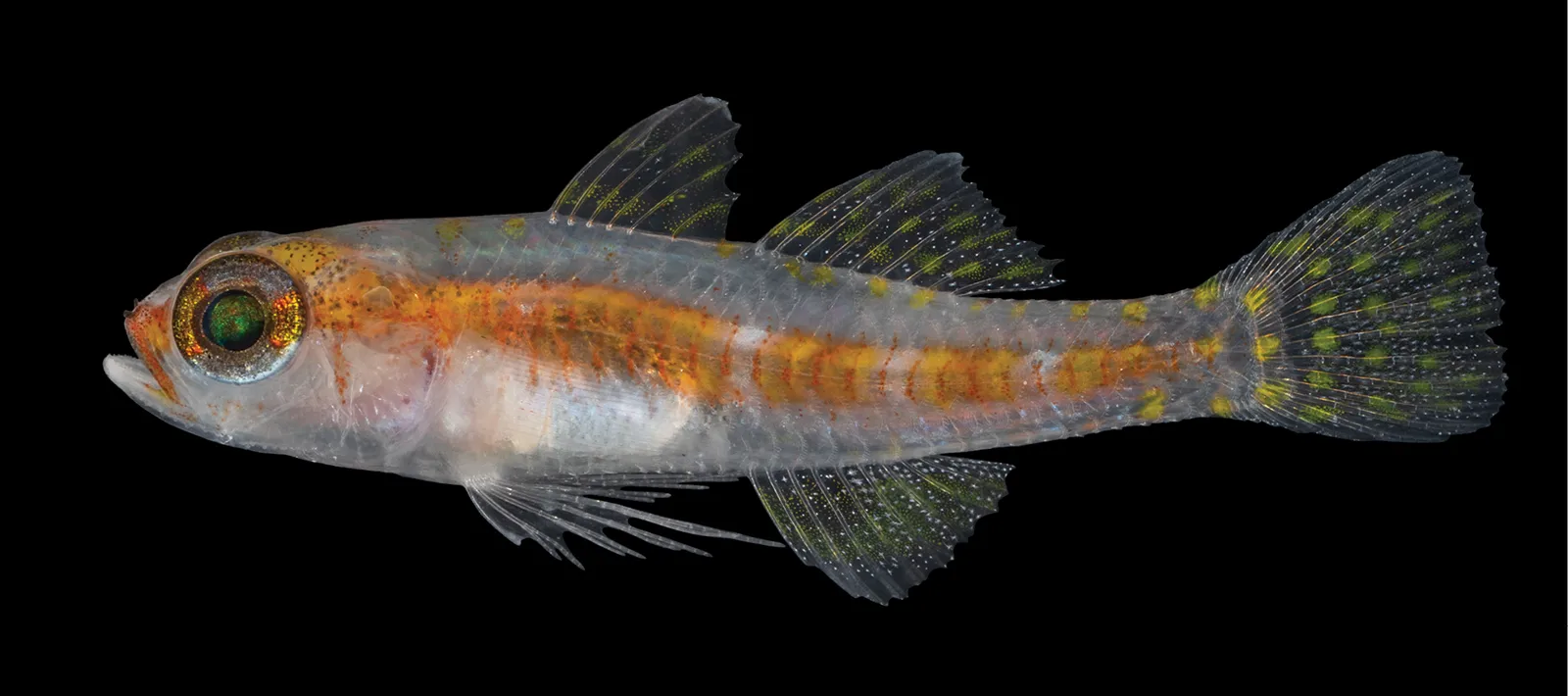
A newly named Red Sea pygmygoby has a translucent body crossed by an orange-red stripe and a tail sprinkled with golden spots. Trimma charon, described in ZooKeys on September 24, 2026, is known from just two fish collected at Walih Island, Saudi Arabia. The description brings the number of named Trimma species recorded from the Red Sea to 11.1
Two fish from a cave entrance
Viktor N. Peinemann and colleagues at King Abdullah University of Science and Technology and the Senckenberg Research Institute studied specimens collected in May 2023. The fish were found about 98 feet (30 meters) down, at the bottom of a cave entrance on a steep outer-reef slope. They rested on dead carbonate substrate rather than among a dense cover of living coral.1
The specimens measured about 0.48 and 0.66 inches in standard length, the distance from the snout to the base of the tail. Those are measurements of the collected fish, not an established maximum adult size. The slope continued below 328 feet (100 meters), leaving much deeper habitat beyond the collection site.1
A broken stripe separates it from a lookalike
Its closest visual match is Trimma anaima, another orange-striped pygmygoby. In T. charon, three narrow pale bars interrupt the stripe, and distinct golden spots decorate the tail. The iris also has alternating white and orange sectors. The researchers compared finer anatomical details, including 14 unbranched pectoral-fin rays, against the 15 to 17 reported for T. anaima. Identification rests on that combination of features, not merely a red stripe.1
The golden spots inspired the name: Charon, the ferryman in Greek mythology, received coins to carry souls across the river Styx. The proposed common name is Charon’s pygmygoby.1
A discovery with husbandry still unknown
Earlier work by Peinemann and colleagues, published in October 2025, described the yellow cave-dwelling Trimma berumeni and examined the relationships of Red Sea Trimma using multiple genetic markers. That study provides background to the region’s unusually localized pygmygoby diversity; it is not a second new discovery announced this month.2
For reef keepers, the useful distinction is between recognizing a fish and knowing how to keep it. This description supplies identification characters and habitat observations, not tested aquarium care requirements. Further surveys found no additional T. charon. The authors leave two explanations open: it may be genuinely rare, or more common below the depths usually surveyed.1
Sources and notes 2 references
- Peinemann et al.: Trimma charon, a new species of pygmygoby from the Red Sea (opens in a new tab)September 24, 2026
- Peinemann et al.: A new cave-dwelling species of Trimma from the Red Sea (background) (opens in a new tab)October 9, 2025
Background: September 24, 2026; October 9, 2025 (background). Published November 6, 2026.
Research and reporting dates are kept as published, and older work isn’t presented as news. Product claims are attributed to their makers. Photos are illustrative and don’t show store stock.