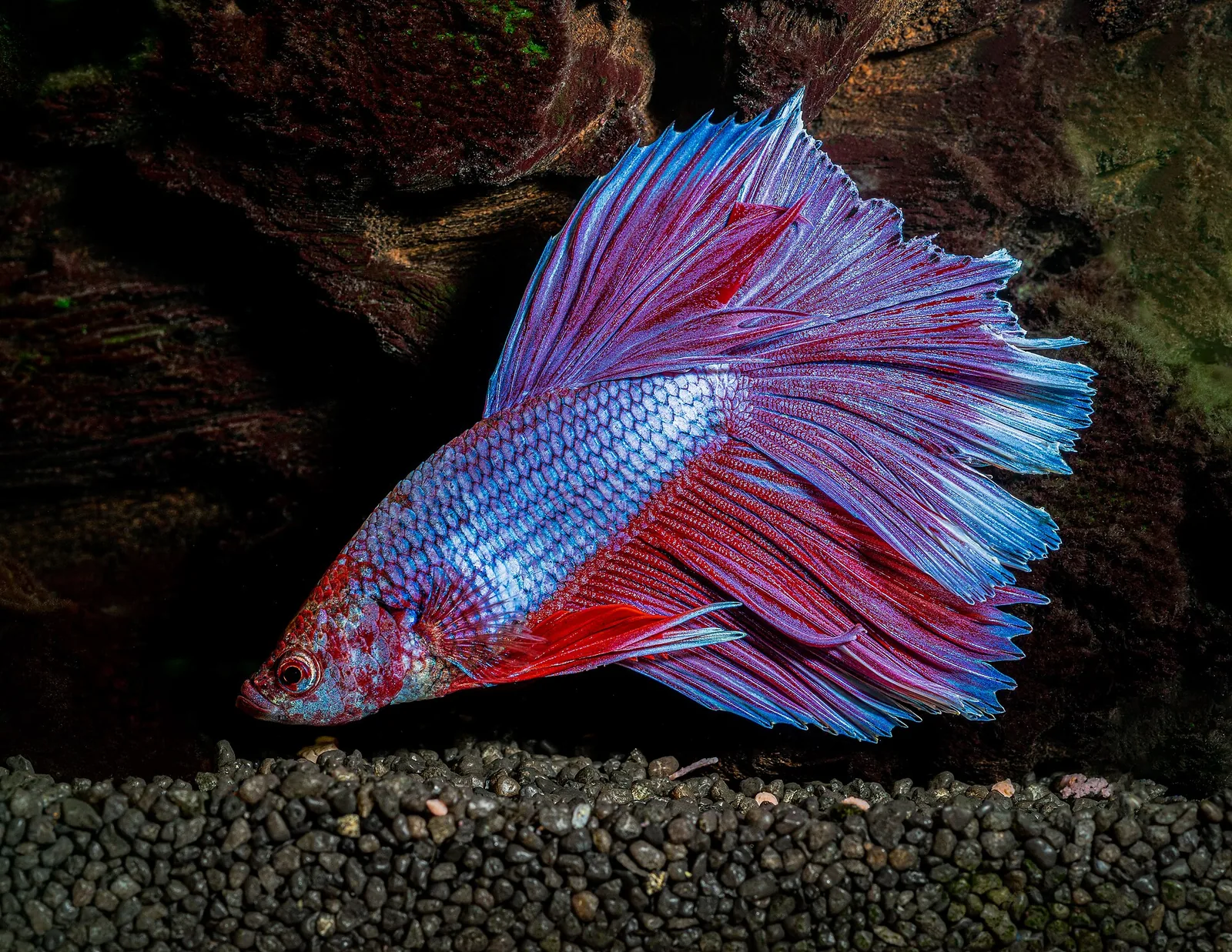
Male bettas usually reach stores in small plastic cups, and many go home to a bowl. Two studies published in 2024 asked whether that much room is enough. Both found that bettas behaved differently once they had more space and something to swim around.4
What the tank-size studies found
Ronald Oldfield and Emily Klerekoper Murphy watched single males in a 0.5-liter bowl (about 0.13 gallon) and in aquariums of 10, 38 and 208 liters (about 2.6, 10 and 55 gallons). The fish swam less in the bowl. The authors concluded that a betta needs at least a 10-liter (2.6-gallon) tank to show its full range of swimming, and fish swam more often when the container held gravel, rocks and live plants.2
Naomi Clark-Shen and colleagues moved 13 males through five setups, from a 1.5-liter jar to 19.3-liter tanks (about 0.4 to 5.1 gallons). In the large furnished tank the fish were more active and spent less time resting, hovering or swimming in repeated patterns. A large tank with no gravel, plants or hiding places produced more of those abnormal behaviors than the furnished one. The team suggested 5.6 liters (about 1.5 gallons) as the least a store should use for display and sale, and a bigger tank at home.3
Where the older advice differs
A 2019 UF/IFAS Extension publication takes another view. It argues that domestic male bettas, which evolved in shallow, warm water, do well in small aquariums and bowls when water quality, nutrition and health care are looked after, and it cites a Thai study in which males grew better in 150 milliliters (about 5 fluid ounces) than in 300. That work measured growth, while the 2024 studies measured behavior, which may account for some of the disagreement.4
Keeping one
UF/IFAS notes that bettas do poorly in cold water. If one lives in an unheated, unfiltered container, the room should stay at 71.6°F or warmer. Bettas prefer calm water, and UF/IFAS cautions that heavy filtration may harm them. Dry commercial foods can be the whole diet, and live or frozen foods are an option on top.4
Keep males apart. In Oldfield and Klerekoper Murphy’s pair trials, bigger planted tanks reduced approaches and displays between two males but not attacks, and the authors found that even very large aquariums could not guarantee the pair would live peacefully. The largest they tested held 378 liters, about 100 gallons.2
Sources and notes 4 references
- FishBase — Betta splendens species summary (opens in a new tab)Accessed November 1, 2026
- Oldfield and Klerekoper Murphy — Life in a fishbowl: Space and environmental enrichment affect behaviour of Betta splendens, Animal Welfare (opens in a new tab)2024
- Clark-Shen et al. — Life beyond a jar: Effects of tank size and furnishings on the behaviour and welfare of Siamese fighting fish, Animal Welfare (opens in a new tab)Published December 23, 2024
- UF/IFAS Extension — Evolution, Culture, and Care for Betta splendens (FA212) (opens in a new tab)March 2019
Background: Species profile; studies published 2024; UF/IFAS March 2019. Published November 1, 2026.
Research and reporting dates are kept as published, and older work isn’t presented as news. Product claims are attributed to their makers. Photos are illustrative and don’t show store stock.