
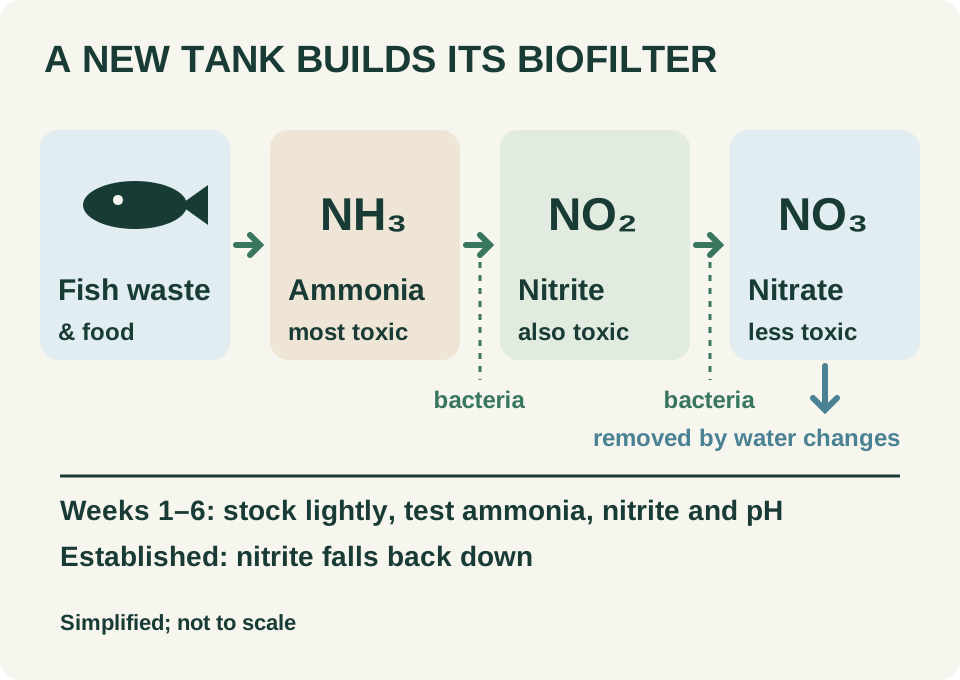
A brand-new aquarium has clean water and almost none of the bacteria that make fish waste safe. Fish food is rich in protein, and fish release the resulting ammonia across their gills. UF/IFAS Extension explains that one group of nitrifying bacteria turns ammonia into nitrite and a second turns nitrite into nitrate, which is generally less toxic. Hobbyists call the wait for those bacteria to settle in cycling.1
The first six weeks
- Wash the gravel, set up the tank and give the heater a full day to bring the water to a steady temperature before any fish go in.
- Dechlorinate the tap water. If your supply uses chloramine, watch for the ammonia it releases.
- Start with only a few fish. UF/IFAS advises a light stocking rate for the first four to six weeks while the biological filter becomes established.
- Test total ammonia, nitrite and pH closely during that time. The filter is established when nitrite drops.1
After that, go slowly
The Ornamental Aquatic Trade Association calls the result of rushing “new tank syndrome”: too few nitrifying bacteria for the waste, so ammonia and nitrite climb to levels that can make fish ill or kill them. Its advice is to raise the number of fish gradually, because the bacteria have to increase every time fish are added and feeding goes up.2
Tank size helps too. The same UF/IFAS guide says larger aquariums are easier to work with than small ones and suggests about 30 gallons as a starter tank, big enough to dilute wastes while the system settles.1
Sources and notes 2 references
- UF/IFAS Extension — Aquarium Setup and Maintenance (VM144) (opens in a new tab)August 2003; archived copy
- Ornamental Aquatic Trade Association — How to look after Siamese fighting fish (Bettas) (opens in a new tab)Undated care sheet
Background: Beginner guide; UF/IFAS VM144 August 2003 (archived); OATA care sheet, undated. Published November 1, 2026.
Research and reporting dates are kept as published, and older work isn’t presented as news. Product claims are attributed to their makers. Photos are illustrative and don’t show store stock.