
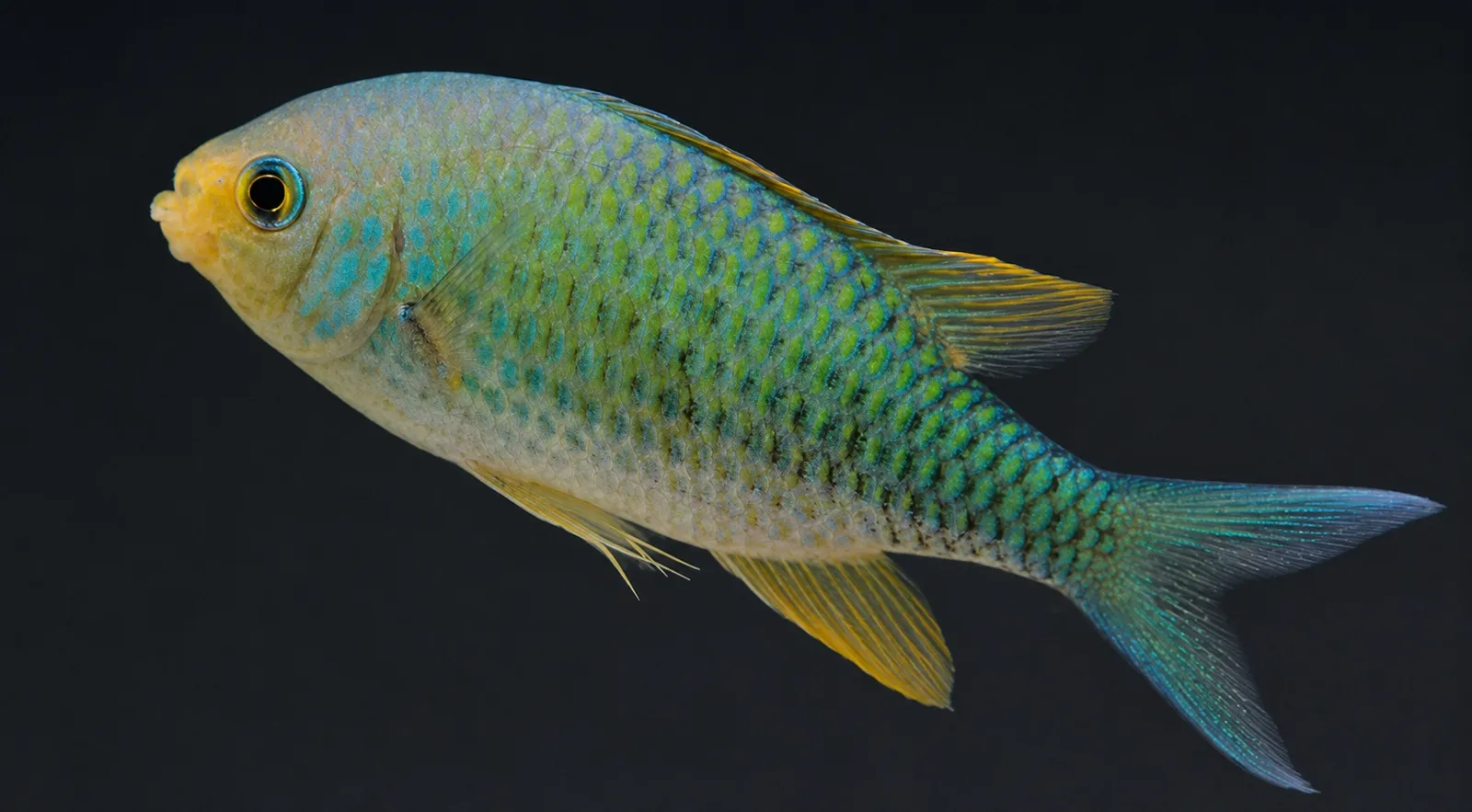
The blue-green fish sold under the familiar name Chromis viridis includes a newly described species, Chromis veneta. A paper published in Frontiers in Marine Science on September 4, 2026, separates the lookalike using DNA and anatomy. This is a change in identification, not the arrival of a newly created aquarium variety.1
Researchers examined blue-green damselfish from India’s Lakshadweep islands and Gulf of Mannar. Their analyses combined five genetic markers with measurements and other physical characters. C. veneta had a more slender body, a narrower tail base and distinctive adult fin margins. The team also found differences in teeth, gill rakers and the small ear stones called otoliths. The agreement between these lines of evidence supported recognizing a separate species.1
The paper documents both species living on the same reefs. Its collection notes also warn against an easy colour shortcut: the yellow fin pigmentation used to distinguish adults was absent in juveniles. A blue-green body alone therefore cannot settle which species a young fish belongs to.1
In a September 8 announcement, ICAR’s National Bureau of Fish Genetic Resources explains why aquarium keepers should care. The newly named fish may have been collected and traded for decades as C. viridis. A familiar commercial name can conceal more than one biological species, even when the fish are widely kept and closely resemble one another.2
The institute reports records beyond India, including Indonesia, Madagascar, Fiji and Australia’s Lizard Island, while noting that the full distribution still needs documenting. It connects accurate identification with captive breeding, conservation and a more reliable ornamental-fish trade. Those are reasons to pay attention to scientific names and collection origins, rather than assume every blue-green chromis has the same identity.2
The announcement also places the discovery in a practical research setting: the team had been investigating captive breeding as an alternative to collecting wild live bait in Lakshadweep. That breeding work preceded the species description. Neither the new name nor the announcement establishes a new minimum tank size, feeding prescription or compatibility rule for home aquariums.2
Sources and notes 2 references
- Rekha et al.: Resolving cryptic diversity in the Chromis viridis species complex, Frontiers in Marine Science (opens in a new tab)Published September 4, 2026
- ICAR–National Bureau of Fish Genetic Resources: new Chromis veneta species announcement (opens in a new tab)September 8, 2026
Background: September 4, 2026 (Frontiers in Marine Science); September 8, 2026 (ICAR). Published November 2, 2026.
Research and reporting dates are kept as published, and older work isn’t presented as news. Product claims are attributed to their makers. Photos are illustrative and don’t show store stock.