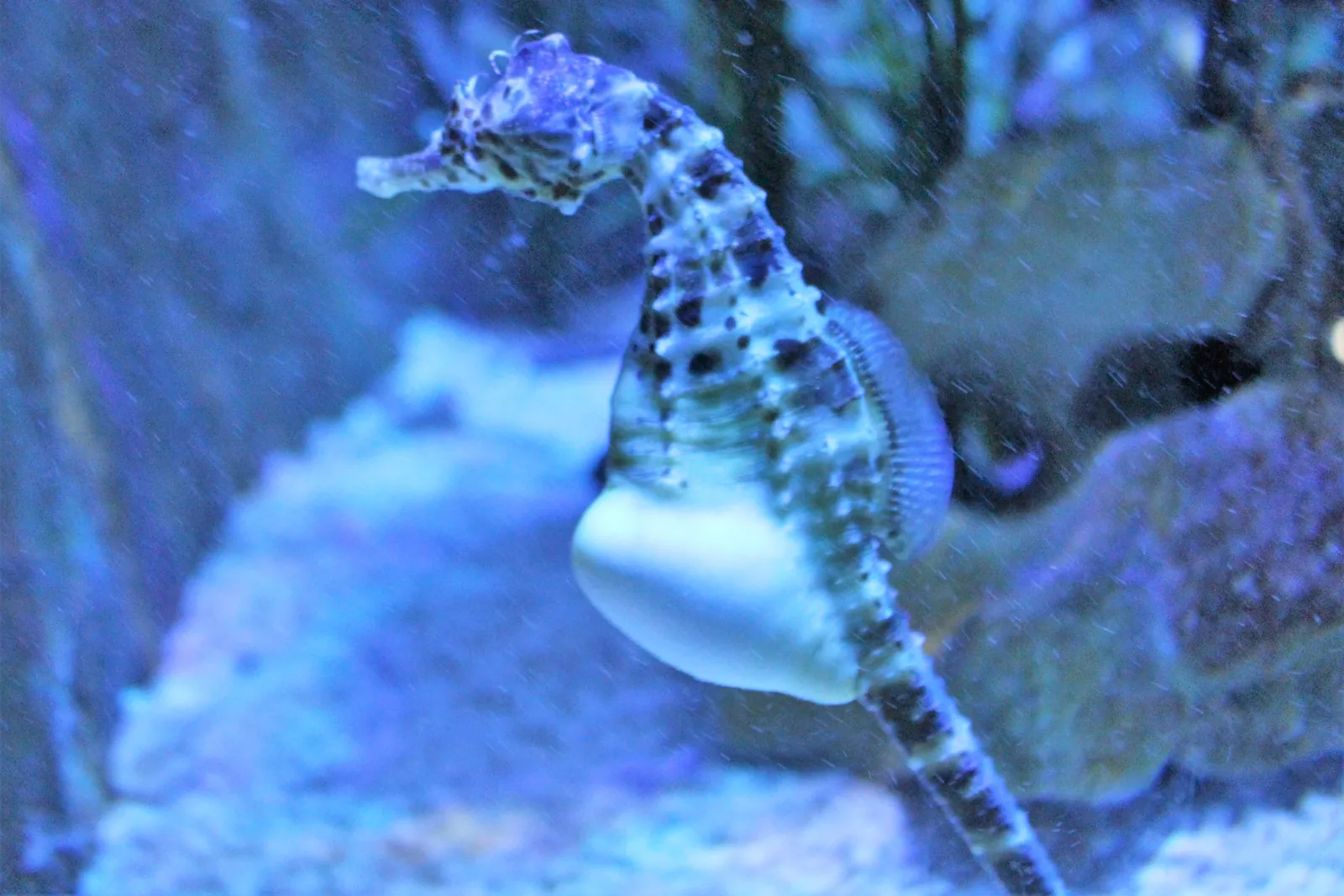
A lined seahorse tank is built upward: tall water, plenty to grip and no fast fish at feeding time. The best-documented guidance comes from public aquariums, collected in a 2005 husbandry manual edited by Heather Koldewey for Project Seahorse and the Zoological Society of London.
Hippocampus erectus, the lined seahorse of the western Atlantic, is one of the seahorses most often kept. The figures below come from large institutional systems, so treat them as a guide to what the fish need rather than a home specification.
How tall should the tank be?
In a survey of 12 public aquariums, tanks were at least 18 inches (45 cm) tall, preferably 21 inches (53 cm) for breeding pairs, which need height to transfer eggs. The 2005 update prefers 31–39 inches (80–100 cm). Adults can reach 6 inches (15.24 cm).1
What do they hold onto?
Seahorses anchor themselves by the tail. As holdfasts the aquariums used artificial sea grass, fake coral, gorgonians and weighted loops of plastic rope.1
What temperature did aquariums use?
Survey temperatures ranged from 55°F to 82°F (13–28°C); four institutions averaged 76–78°F (24.5–25.5°C) and five 72–73°F (22–23°C).1
Which tankmates work?
Most limited companions to species that will not outcompete seahorses for food, and avoided cnidarians with a potent sting.1
What do they eat?
Adults were fed frozen mysis shrimp one to three times a day. The species can be picky, so the authors recommend a variety of foods.1
Why start with captive-bred seahorses?
Wild-caught seahorses often go unfed in poor water during collection and transport, the manual notes, and many die in the weeks after arrival; it recommends captive-bred animals first. It also calls the adults susceptible to many diseases and parasites.1
A stable, clean, mature system and an unhurried feeding routine are the core of the project.
Trade is regulated as well. All seahorses are listed on Appendix II of CITES, Project Seahorse explains, which means exports must be sustainable, legal and monitored.2
Sources and notes 2 references
- Koldewey (editor): Syngnathid Husbandry in Public Aquariums, 2005 manual (Project Seahorse and Zoological Society of London), lined seahorse chapter by Martínez, Gardner and Littlehale (opens in a new tab)2005
- Project Seahorse: Regulating legal trade (CITES) (opens in a new tab)undated; read November 2, 2026
Background: Species setup guide; public-aquarium husbandry manual, 2005. Published November 2, 2026.
Research and reporting dates are kept as published, and older work isn’t presented as news. Product claims are attributed to their makers. Photos are illustrative and don’t show store stock.