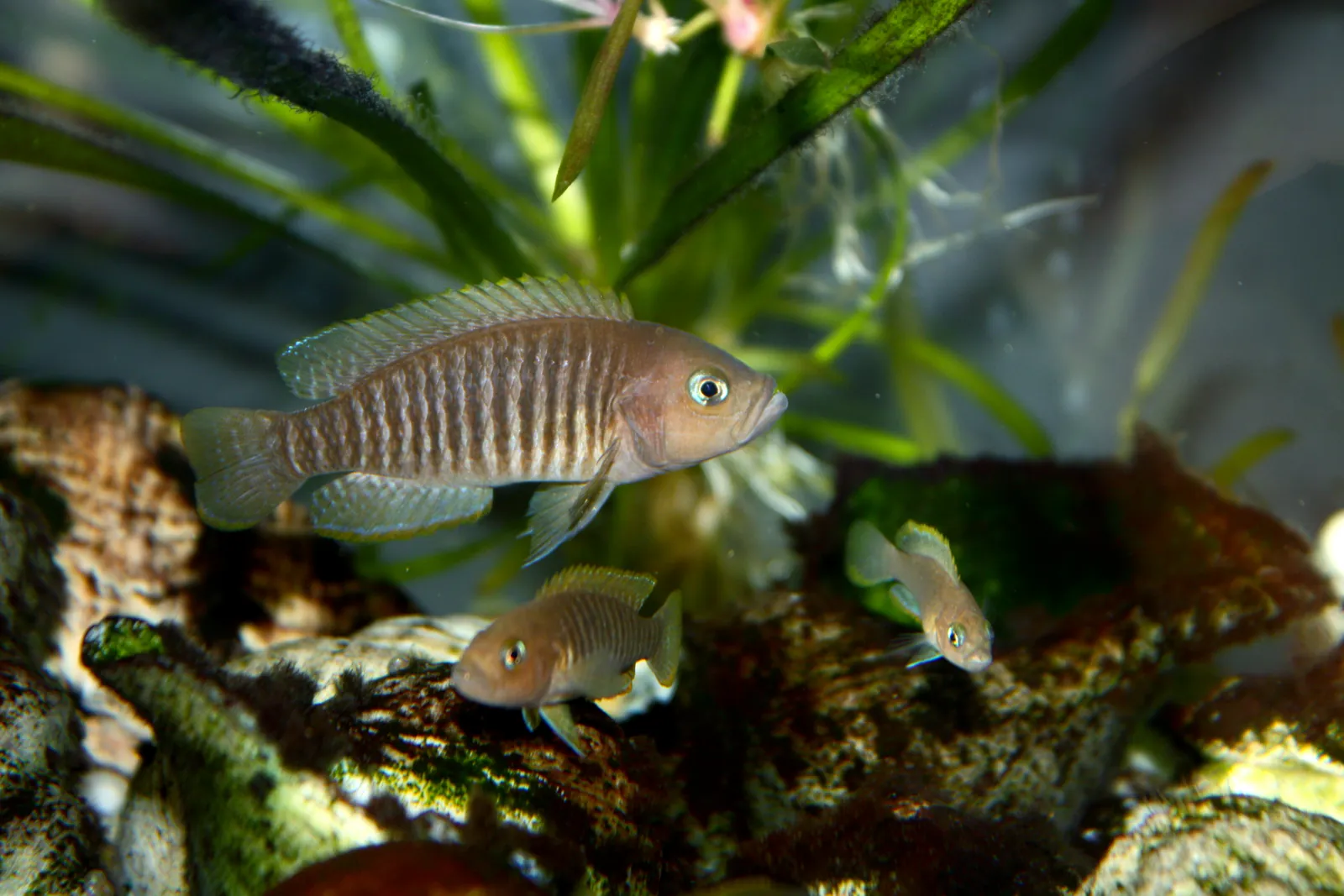
A tank for Neolamprologus multifasciatus is mostly floor: open sand, a scatter of empty snail shells and room for a small colony to divide up. Seriously Fish calls this Lake Tanganyika fish probably the smallest known cichlid, at about 1.8 inches standard length.1
In the lake, researchers at the University of Konstanz report, multis live in stable groups of up to 20 that last for years: a dominant male, adult females, juveniles and subordinate males. Each fish has its own home shell that it digs out of the lake floor and defends fiercely, while the group defends its territory together.2
1. Size the tank for the group you want
Seriously Fish gives 18 by 12 by 12 inches, about 10.6 US gallons (40 liters), for a single pair, and says a colony needs a larger tank. Each territory is usually no more than 6 inches across, so the floor area sets how many fish can claim space.1
2. Lay sand at least 2 inches deep
Multis dig, so Seriously Fish asks for open sand at least 2 inches deep.1
In the wild they excavate sand from inside their shells, leaving shell-filled hollows separated by ridges of sand.3
3. Add more shells than fish
Provide more empty shells than fish, spaced a little apart to ease squabbling between males; Seriously Fish suggests escargot shells. Females half-bury their chosen shell and lay eggs inside.1
Shell quality matters. In a 2020 experiment with 3D-printed replicas, multis preferred shells that were intact, larger, longer or wider at the opening, and intactness counted most. Chipped or broken shells are the least useful.3
4. Match the water and stock the group
The profile lists 75–81°F (24–27°C), pH 7.5–9.0 and 8–25 dGH, with more females than males in a colony and mostly live and frozen foods.1
Suggested tankmates use other parts of the tank: small rock dwellers such as smaller Julidochromis, or open-water Cyprichromis.1
5. Keep the advice species-specific
All of these figures are for N. multifasciatus. Other shell-dwelling cichlids differ in size, group life and temper, so look up each species separately before mixing them or reusing this layout.
Sources and notes 3 references
- Seriously Fish: Neolamprologus multifasciatus species profile (opens in a new tab)undated; read November 2, 2026
- Jordan, Lein, Ma and Bose: Societies of the shell-dwelling cichlid Neolamprologus multifasciatus (Animal Behaviour) (opens in a new tab)December 1, 2025
- Bose and others: Structural manipulations of a shelter resource reveal underlying preference functions in a shell-dwelling cichlid fish (Proceedings of the Royal Society B) (opens in a new tab)May 20, 2020
Background: Species setup guide; research from 2020 and December 2025. Published November 2, 2026.
Research and reporting dates are kept as published, and older work isn’t presented as news. Product claims are attributed to their makers. Photos are illustrative and don’t show store stock.