
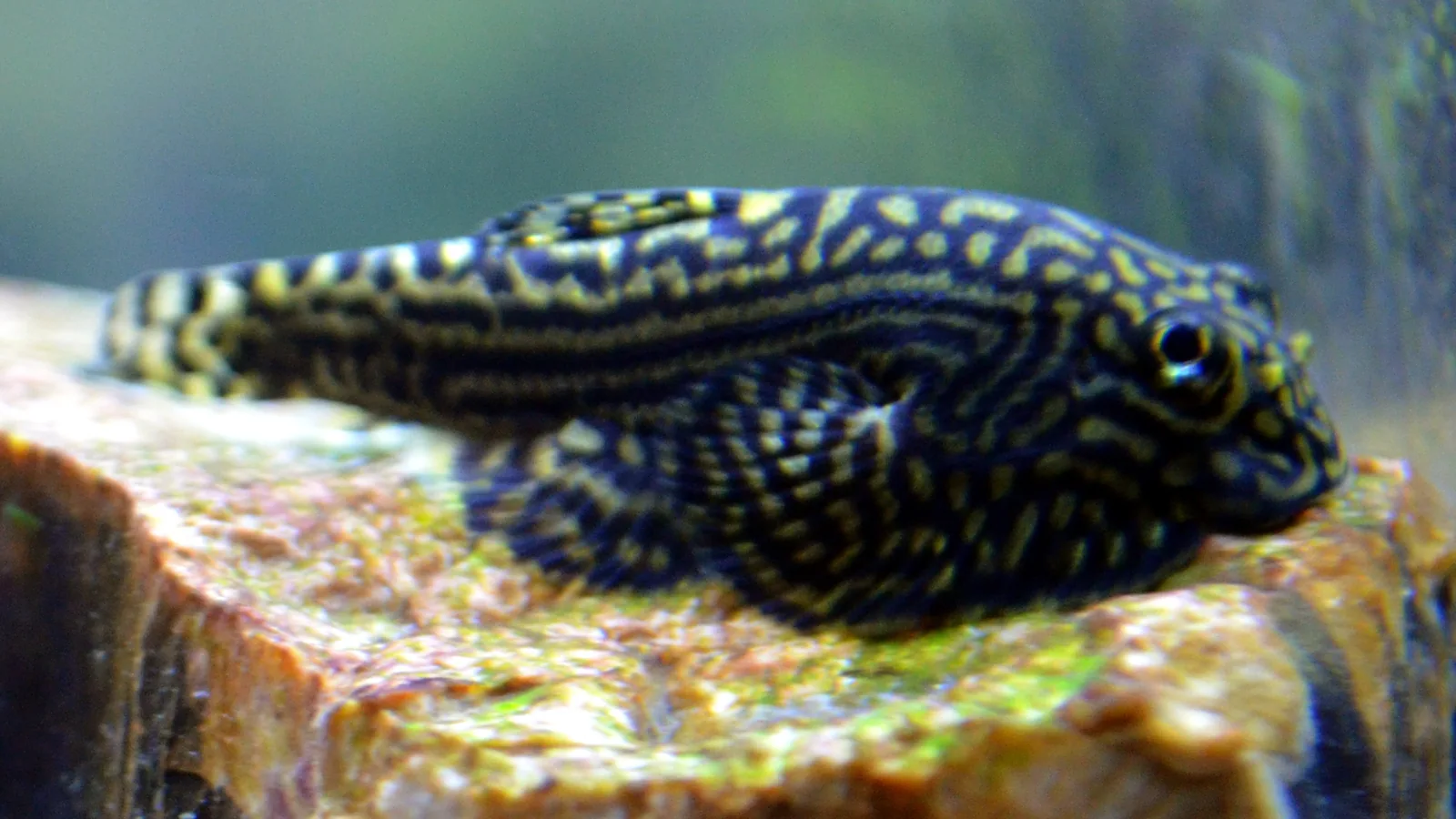
Hillstream loaches do best in a long, low tank where the water runs one way over smooth, algae-covered stones, with plenty of oxygen and a temperature on the cool side of tropical. Seriously Fish describes the home streams of the tiger hillstream loach, Sewellia lineolata, in central Vietnam as shallow, fast and oxygen-saturated, with riffles and pools over bedrock, boulders, gravel and sand. Sunlight grows a rich biofilm over submerged surfaces there, and water plants are usually absent.3
Start with floor space
For Sewellia lineolata, which grows to about 2.6 inches standard length, Seriously Fish recommends a base of at least 30 by 12 inches, roughly 18 US gallons.3
Its butterfly loach profile asks for at least 24 by 12 inches (about 14 gallons) for Beaufortia kweichowensis, a 3-inch fish from southern China and one of the hillstream loaches most often seen in shops.4
Practical Fishkeeping’s hillstream guide by Emma Turner goes bigger: a tank that is long rather than tall, with 48 by 15 by 18 inches given as a workable size and nothing shorter than 36 inches, because one-way flow works better the longer the tank.2
The figures differ, but they agree on the shape: fish that spend their lives clinging to the bottom need floor space more than height. Treat the smaller sizes as minimums and the longer tank as the comfortable choice for a group.
Make the water run in one direction
Turner recommends a strong current, one-directional if possible, and a high oxygen level. She warns that simply adding powerheads makes the water tumble around the tank instead of running down it, and she advises against ball-shaped stream pumps: a flat-bellied loach can be pulled against the guard around the impeller and be unable to get off.2
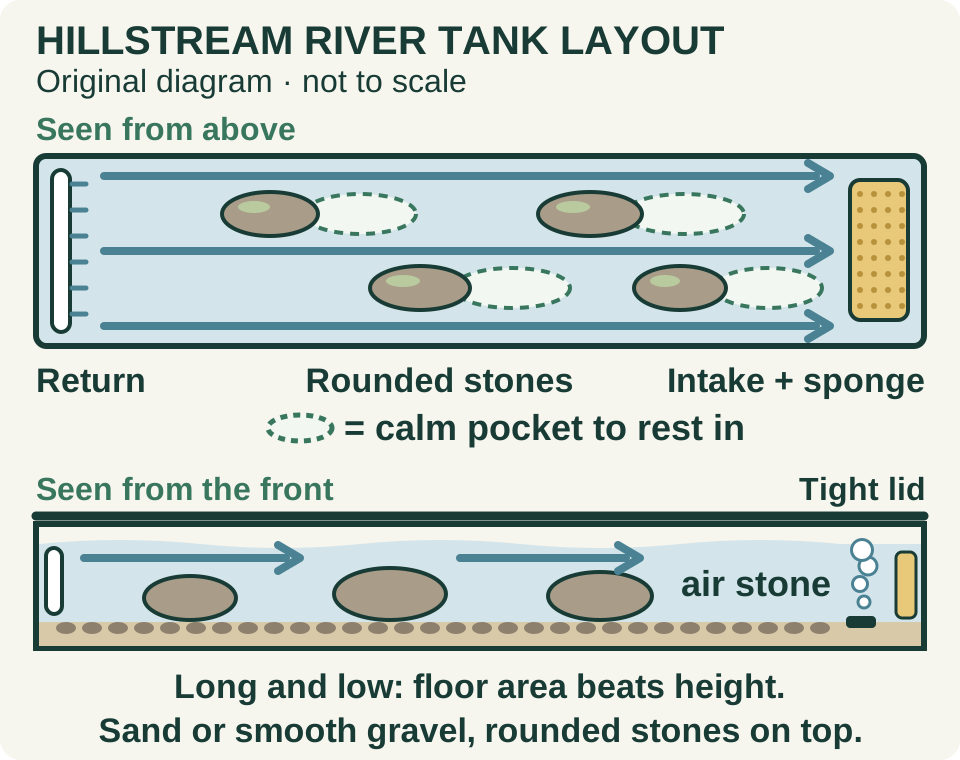
The diagram shows a simple way to get a single direction of flow. The filter return, ideally a spray bar, sits at one end and points down the length of the tank. The intake sits at the far end behind a sponge, so the water crosses the whole tank before it leaves and small fish, fry and food stay out of the filter. Large rounded stones between the flow lanes leave calm water on their downstream side where the fish can rest.
Seriously Fish suggests an oversized filter as a minimum, with extra powerheads or air stones where needed, and notes that an exposed filter sponge doubles as a grazing surface.4
Smooth stones carry the food supply
Turner suggests sand, or a mix of sand, smooth gravel and water-worn cobbles, and notes that sharp gravel can injure bottom-dwelling fish. Anubias and Java fern can be tied to rocks above the fastest water, though these fish meet few plants in the wild.2
The stones are also the larder. The Beaufortia profile says the loaches graze biofilm and need stable conditions, so they should never go into a new, immature tank. It recommends strong lighting to grow algae and its micro-organisms, letting that growth cover every surface except the front glass, and a tight-fitting cover, because these fish can climb glass.4
Cool water holds more oxygen
Seriously Fish gives 68–75°F (20–24°C) for Sewellia lineolata and 61–75°F (16–24°C) for the butterfly loach, and says both cope with warmer spells only while dissolved oxygen stays high.34
Turner’s range for hillstream and brook loaches in general is 65–77°F (18–25°C), with an air stone as a backup in an unusually hot spell. She adds that these fish will not thrive in a standard community aquarium.2
Cold water can hold more dissolved oxygen than warm water, the U.S. Geological Survey explains, so a warm room cuts the oxygen these fish depend on.5
Pick tankmates from fast water
Seriously Fish recommends a group of six or more Sewellia; males squabble over feeding spots but rarely bother other species. Suggested companions include small fast-water fish (Tanichthys, Danio, Rasbora) and stream gobies (Rhinogobius, Stiphodon). Gentler hillstream loaches like Gastromyzon tend to lose food and space to Sewellia.3
One reader’s river tank
In December 2025 Practical Fishkeeping published reader James Taylor’s homemade river tank: 48 inches long but only 6 inches high, stocked only with Sewellia lineolata. Two adjustable pumps push water through hoses under the sand, foam blocks cover their intakes, and a small canister filter draws from one end and returns at the other to keep the flow in a line. Taylor lists the snags. A badly placed rock threw water over the top, and current too low down lifted the sand. Plants washed away when he forgot to turn the pumps down before planting. Food blew straight into the foam, so he turns the flow off to feed or uses foods that hold together in current, and ordinary aquarium lights proved too strong over such shallow water. He grew algae on the rocks for a few weeks before adding fish, and the loaches now breed often enough that he plans a larger tank.1
His depth and pump setup were his own choices for a custom showpiece, and none of these sources gives a pump size to copy. A standard long tank with a return at one end, a sponge-covered intake at the other and rounded stones between them follows the same idea.
Sources and notes 5 references
- Practical Fishkeeping: Homemade high flow, shallow river tank (reader’s tank by James Taylor) (opens in a new tab)December 1, 2025 (updated December 3, 2025)
- Practical Fishkeeping: How to keep hillstream and brook loaches in the aquarium (Emma Turner) (opens in a new tab)June 13, 2016 (site date)
- Seriously Fish: Sewellia lineolata (tiger hillstream loach) species profile (opens in a new tab)undated; read November 2, 2026
- Seriously Fish: Beaufortia kweichowensis (butterfly loach) species profile (opens in a new tab)undated; read November 2, 2026
- U.S. Geological Survey Water Science School: Dissolved oxygen and water (opens in a new tab)undated; read November 2, 2026
Background: Species setup guide; reader’s tank published December 1, 2025. Published November 2, 2026.
Research and reporting dates are kept as published, and older work isn’t presented as news. Product claims are attributed to their makers. Photos are illustrative and don’t show store stock.
Browse air pumps in the shop.