
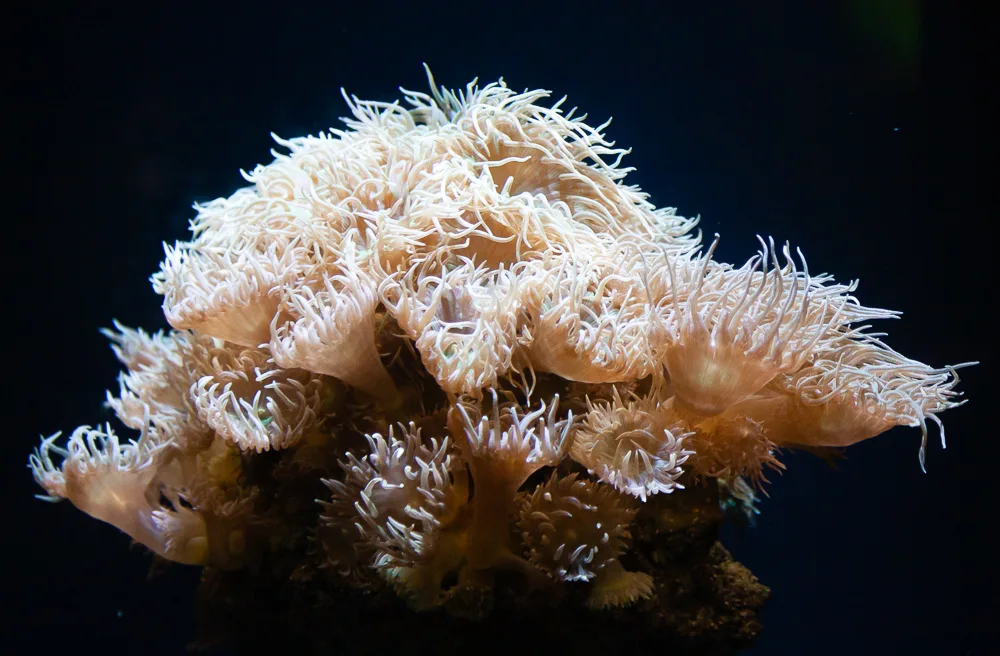
Choose a coral's position from its care requirements and the flow at that location, not a single tank-wide turnover target. EcoTech Marine identifies livestock, rockwork, aquarium size, pump placement and other flow sources as factors in choosing a pump mode. Our practical conclusion: a pump specification is a starting point, not a placement map.1
One grower, two corals, two placements
ORA describes its Duncanopsammia axifuga as an LPS coral and recommends moderate-to-strong flow, medium-to-high lighting and a middle-to-upper position. The page concerns ORA's particular cultured Duncan, including its tightly clustered growth form. It is useful starting information for that stock, not permission to assign every large-polyp coral the same place.2
For its Montipora setosa, an SPS coral, ORA instead lists low-to-moderate flow and bottom-to-middle placement, again with medium-to-high lighting. The grower describes tolerance of a range of conditions. Taken together, these examples show why “SPS means strongest flow” and “LPS means weakest flow” are inadequate purchasing instructions. Ask for the actual coral's care information rather than stopping at its broad hobby category.23
Keep a placement record
- Sketch the rockwork and pump positions. Note other flow sources and obstructions; EcoTech explicitly identifies these as relevant.
- Write the coral's identity and grower's flow and lighting guidance beside the proposed location. Keep separate entries for different corals.
- Save a photograph and the pump settings before making a change. Our preference is to document one adjustment at a time rather than rearrange everything together.1
Treat the record as an ongoing husbandry conversation, not proof that the first placement is correct. If the coral appears unwell, describe the observations and seek species-specific help rather than repeatedly increasing pump power. This guide deliberately supplies neither a universal turnover number nor a promise that one setting suits every colony.
Sources and notes 3 references
- EcoTech Marine — What VorTech mode is best? (opens in a new tab)undated
- ORA — Duncan (Duncanopsammia axifuga) (opens in a new tab)undated
- ORA — ORAnge Setosa (Montipora setosa) (opens in a new tab)undated
Background: Evergreen guide. Published November 1, 2026.
Research and reporting dates are kept as published, and older work isn’t presented as news. Product claims are attributed to their makers. Photos are illustrative and don’t show store stock.