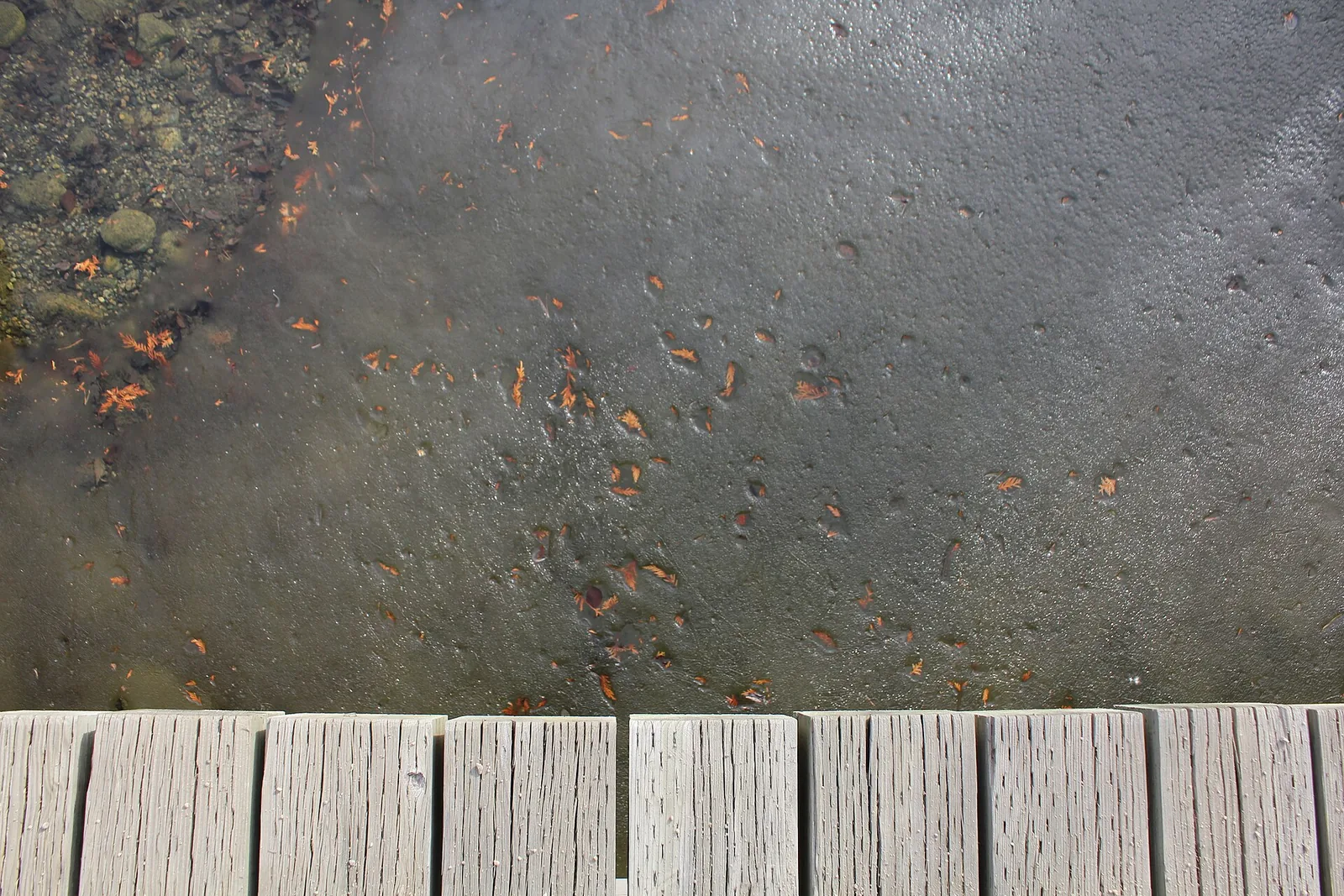
Fish in a backyard pond get through a cold winter on the oxygen already in the water. Penn State Extension explains how that supply runs short. Ice stops oxygen moving in from the air, snow on the ice cuts the light that plants and algae need to make more, and rotting leaves and plants on the bottom keep using it up. Fish lost this way are called winterkill, and Penn State notes that a bottom covered in leaves and dead plants makes it more likely.1
Work through these in November
- Net or skim out fallen leaves. K-State Research and Extension lists leaf netting or skimming as fall work.
- Stop feeding fish once the water is below 50°F, and wait until it is back above 50°F in spring before you start again. Our suggestion: read a thermometer in the pond water rather than going by the air temperature.
- Lower tender plants when a heavy frost is coming, and trim hardy submerged plants to below the level the ice will reach.
- Turn off waterfalls, streams and fountains. Clean the biofilter, then winterize the pump and the UV unit.
- Set up a winter bubbler or de-icer to hold an opening in the ice. Never hit the ice to break it: K-State warns that the shockwave can kill fish, and it is hard on the liner too.2
A few cautions
Penn State’s advice is written for farm ponds and small lakes. It suggests running an aeration system once ice forms and leaving it off while the pond is open. Garden ponds differ a great deal in depth, size and stocking, so use these steps as a checklist and follow the instructions for your own equipment.1
Penn State also suggests keeping about 30% of the ice free of lasting snow so light reaches the water, but only where the ice is safe to work on.1
If you clean the pond before winter, K-State advises against power-washing the liner. The film on its sides is home to useful microorganisms.2
Sources and notes 2 references
- Penn State Extension — Winterkill in Ponds (opens in a new tab)Updated May 19, 2025
- K-State Research and Extension — Water Gardening: Maintenance (MF2913) (opens in a new tab)June 2010
Background: Seasonal guide; Penn State Extension updated May 19, 2025; K-State June 2010. Published November 1, 2026.
Research and reporting dates are kept as published, and older work isn’t presented as news. Product claims are attributed to their makers. Photos are illustrative and don’t show store stock.