
Before buying a marine fish, write a plan for its adult life rather than its current display size. Start with the scientific name, expected adult dimensions and the animals already living in your tank. Our recommendation is to leave unresolved questions on paper instead of bringing them home in a fish bag.
Take these questions to the fish room
- Identity and housing: What exact species is offered, what adult size is documented, and can the present aquarium accommodate it?
- Social fit: What is known about this species with its own kind and with each existing resident? Ask for the reasoning, not just a “community” label.
- Feeding fit: Could any current fish or invertebrate be prey? Can you provide the proposed fish's normal diet?
- Contingency: Who can help assess a conflict, and what suitable separate accommodation is genuinely available if the combination fails?
Plan for the adult size
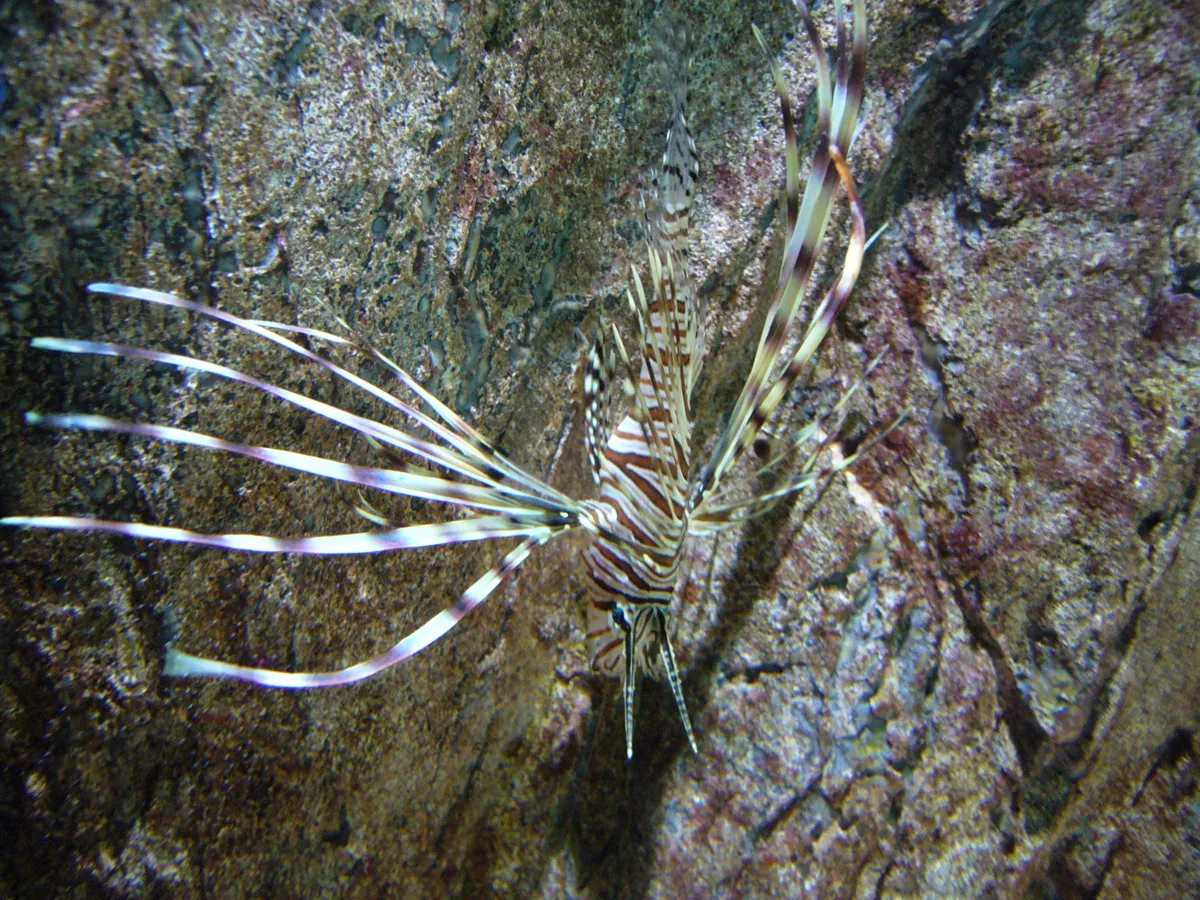
NOAA's account of red lionfish and devil firefish notes that juveniles can measure an inch or less while adults can reach 18 inches. That contrast is a reason to research the species before purchase, not a formula for calculating tank volume. Ask an experienced marine keeper to assess your tank's dimensions and layout for the adult animal; “I will upgrade later” is not an existing home. Lionfish also have venomous spines; they are examples here, not a beginner stocking recommendation.1
Check social behavior separately
Florida Museum identifies its blue tang as Acanthurus coeruleus. It reports a length of approximately 12 inches and describes wild individuals living alone, in pairs or in groups, with reef crevices used as nighttime shelter. Those observations do not establish that several will share your aquarium successfully. A photograph of wild schooling is not a tested captive stocking plan.2
Predation is a separate compatibility question from chasing. Georgia Aquarium lists small fish, shrimp, crabs and other invertebrates in the red lionfish's diet and describes it as a solitary hunter. It also reports that adults defend their home range against other lionfish and other species. Our takeaway is to assess potential prey as well as potential rivals. A quiet fish is not necessarily a safe neighbor for every smaller resident.3
Do not buy a fish merely to fill an empty visual space. If adult housing or compatibility remains uncertain, keep it off the purchase list. These examples explain what to investigate; they do not endorse a particular pairing, group size or minimum tank volume.
Sources and notes 3 references
- NOAA National Ocean Service — What is a lionfish? (opens in a new tab)undated
- Florida Museum — Blue Tang (Acanthurus coeruleus) (opens in a new tab)Updated May 29, 2025
- Georgia Aquarium — Red Lionfish (opens in a new tab)undated
Background: Evergreen guide. Published November 1, 2026.
Research and reporting dates are kept as published, and older work isn’t presented as news. Product claims are attributed to their makers. Photos are illustrative and don’t show store stock.