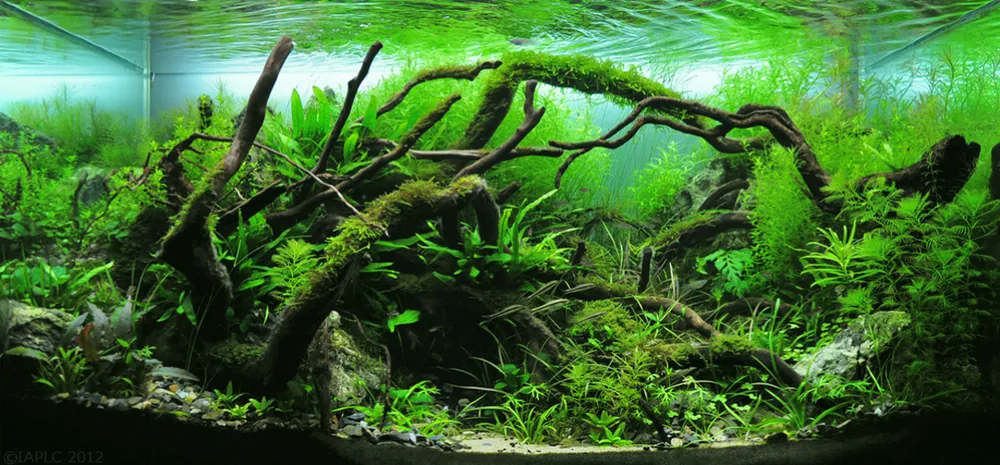
Before turning up the light, make a plant list. Do you want a few leafy accents on wood, an open foreground, or a carpet? Put each plant's requirements beside its name. The equipment decision becomes much easier to think about when you know what you want it to grow.
Check each plant's own rating
Two compact plants can ask quite different things of a tank. Tropica rates Anubias barteri nana as low in light demand, while its Eleocharis pusilla 'Mini' has a medium rating. Both can suit a small layout; they are not interchangeable lighting projects. The useful question is not whether a plant looks beginner-friendly, but what its individual care information says.12
Look past watts
Watts tell you about electricity use, not a directly comparable amount of light across different technologies. Tropica's lighting guide makes that distinction and offers lumen-per-liter bands as a starting point. It also says those recommendations grew out of experience with T5 fluorescent lighting. Treat them as a grower's guide, not a measurement of what reaches a particular leaf under your LED.3
For a closer look, an underwater PAR meter measures the light arriving at a planting position. Its reading is called photosynthetic photon flux density: how many photons arrive per unit of area and time in the conventional 400–700-nanometer range. Apogee's documentation explains why the sensor must also account for the immersion effect. Use a meter intended or correctly configured for underwater measurements; waterproofing a sensor alone is not enough.4
Before buying a fixture
- Where will the demanding plants sit? Tropica's measurements show that distance below a lamp and position toward the corners can change the available light substantially. A specification for the fixture does not describe every planting position.
- What else does the plant need? Tropica distinguishes plants that can manage without supplementary CO2 from more demanding choices. A brighter fixture does not remove the need to consider carbon and other nutrients.
- Is the schedule deliberate? Tropica's growing-in guide recommends a shorter lighting period during a new planting's early weeks, then a longer one later. That is establishment guidance, not a single timetable for every established aquarium.356
Keep a lighting log
Our practical preference is to keep a small lighting log: plant names, fixture setting, on-and-off times, and a photograph from the same position. Write down what you change rather than relying on how bright the tank looked last weekend. If you are comparing settings, resist changing the whole arrangement at once. Give yourself a record you can actually interpret.
And leave room for a modest ambition. A few well-chosen plants around a piece of wood can be the finished design, not an unfinished version of a carpeted aquascape. Choose the aquarium you want to live with, then choose its light.
Sources and notes 6 references
- Tropica Aquarium Plants — Anubias barteri nana (opens in a new tab)undated
- Tropica Aquarium Plants — Eleocharis pusilla 'Mini' (opens in a new tab)undated
- Tropica Aquarium Plants — Light (opens in a new tab)undated
- Apogee Instruments — PAR Meters for Aquariums (opens in a new tab)undated
- Tropica Aquarium Plants — Fertiliser and CO2 (opens in a new tab)undated
- Tropica Aquarium Plants — Growing-in (opens in a new tab)undated
Background: Evergreen guide. Published November 1, 2026.
Research and reporting dates are kept as published, and older work isn’t presented as news. Product claims are attributed to their makers. Photos are illustrative and don’t show store stock.
Browse LED aquarium lights in the shop.