
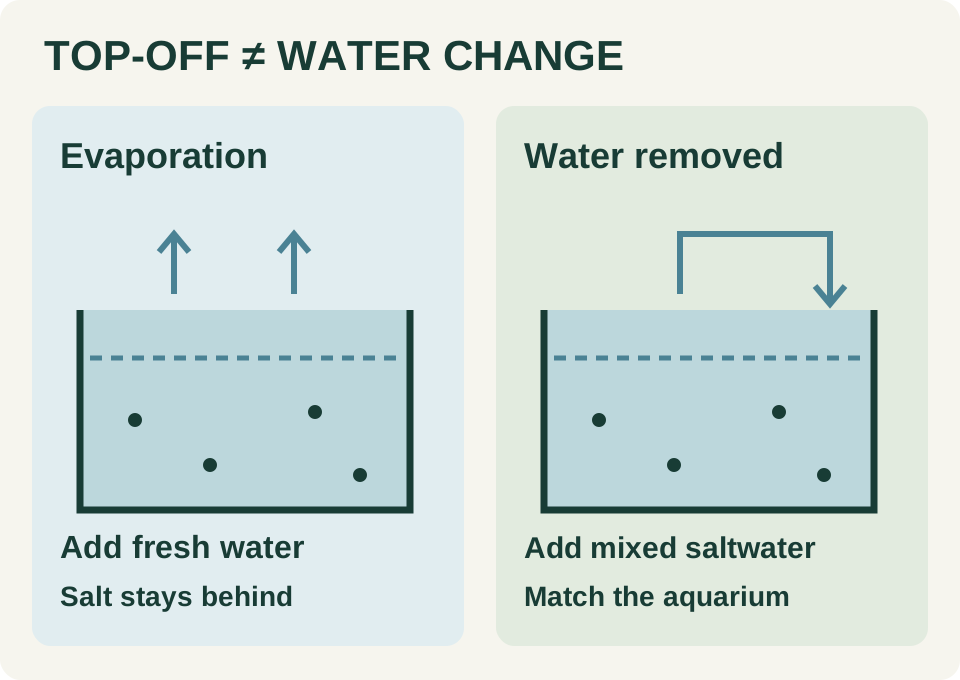
Evaporation removes water while leaving salt behind. Replace that loss with suitable freshwater, not another batch of saltwater. UF/IFAS specifies fresh reverse-osmosis water for this job. A water change is different: you deliberately remove aquarium water, including its dissolved salt, and replace it with prepared saltwater. Do not treat these two jobs as interchangeable bucket refills.13
Which job is it?
- Top-off: replace water lost through evaporation. Do not assume every unexplained fall in water level is evaporation; investigate a possible leak or other removal first.
- Water change: prepare a separate batch of saltwater. Follow the salt manufacturer's mixing directions rather than adding dry salt directly to the occupied aquarium.13
Before you adjust salinity
- Use an instrument intended for seawater and follow its own calibration procedure. For its HI98319 conductivity-based tester, Hanna specifies a fresh calibration standard, rinsing and drying before calibration, clearing trapped bubbles during measurement, and waiting for the stability indicator. Those instructions belong to that instrument; do not transfer a different meter's calibration recipe to yours.
- Record the unit as well as the reading. The Hanna tester can display ppt, PSU or specific gravity: a number without its selected scale is an incomplete record. Our suggested log includes the instrument, calibration date, temperature, tank reading and replacement-water reading. Repeat an unexpected result after checking the procedure before deciding what to change.2
Compare before pouring
Red Sea recommends testing both the aquarium and newly mixed water before a change, and bringing dissolved replacement water to the aquarium's temperature. Follow your salt's mixing and storage instructions; one formulation's timings are not a universal recipe.3
Label containers by what's in them
Our suggestion: label containers by purpose, not merely by color. Write “freshwater top-off” or “prepared saltwater,” plus the preparation date. Keep the test record with the batch. If salinity is unexpectedly wrong, pause routine maintenance and establish a tank-specific correction plan; this guide does not prescribe a universal correction dose or speed.
Sources and notes 3 references
- UF/IFAS — Marine Aquarium Project Book, page 22 (opens in a new tab)June 2023
- Hanna Instruments — HI98319 instruction manual (opens in a new tab)undated
- Red Sea — How to mix perfect saltwater from Red Sea Salts (opens in a new tab)undated
Background: Evergreen guide. Published November 1, 2026.
Research and reporting dates are kept as published, and older work isn’t presented as news. Product claims are attributed to their makers. Photos are illustrative and don’t show store stock.