A fragment can grow into another coral colony without creating another genetic identity. Sexual reproduction does something different: eggs and sperm combine, producing offspring with new combinations of genes. That distinction matters whenever a restoration project counts its corals. More colonies and more genetic variety are not interchangeable measures of progress.2
A fragment grows; a larva settles
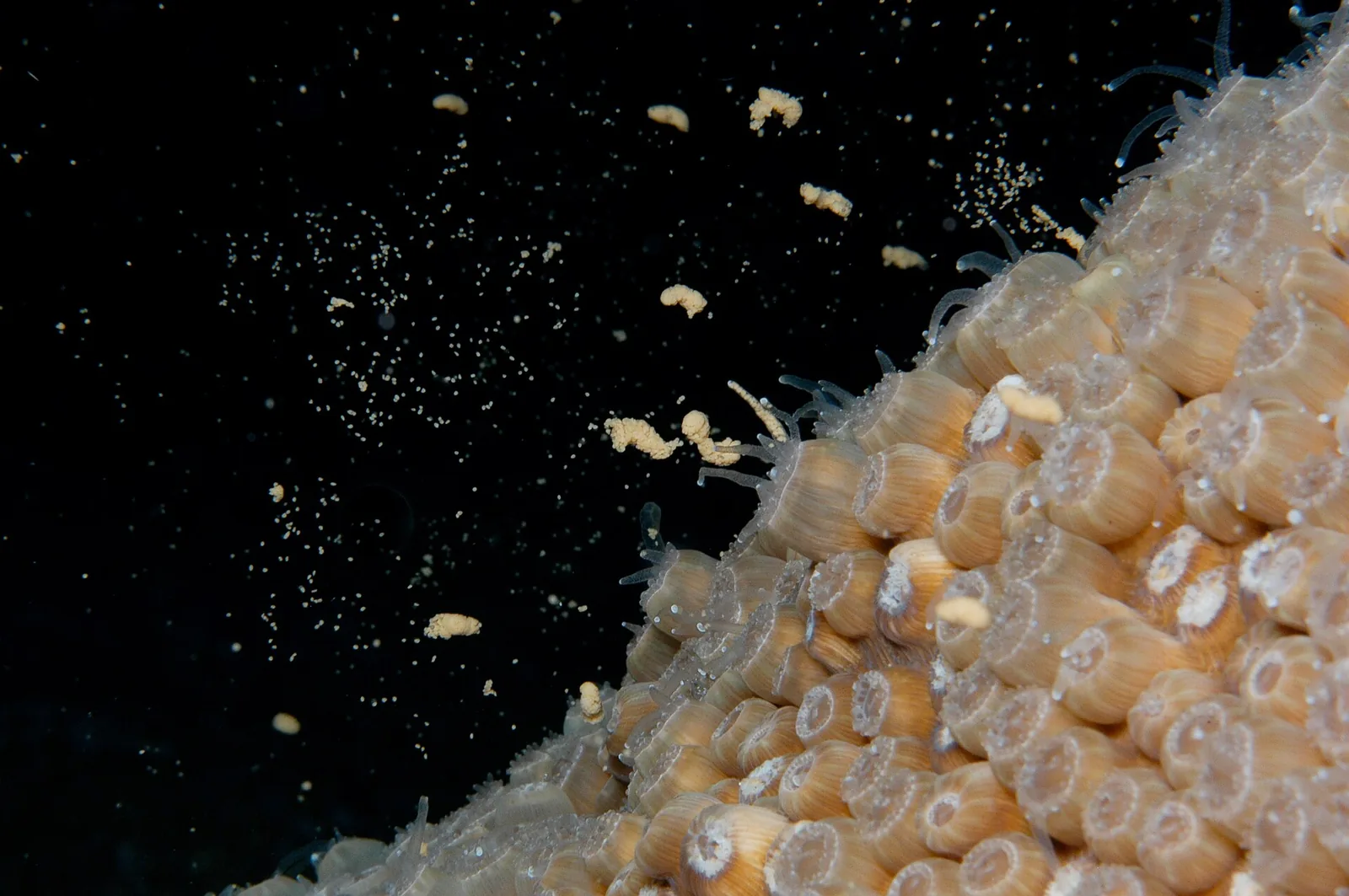
Broadcast-spawning corals release eggs and sperm into the water. Their timing helps gametes from separated colonies meet; temperature, lunar cycles and light contribute to that coordination. After fertilization, embryos develop into swimming larvae called planulae. A suitable surface and settlement cues help a larva make the transition to an attached polyp. Brooding corals take a different route: fertilization and early development occur inside the parent before larvae are released.2
For restoration, producing larvae is therefore an opening, not the finish. Young corals must survive settlement and early growth. Miller and colleagues’ 2024 research paper describes this period as particularly vulnerable to competition, predation and disease. A successful spawning night can supply a new generation; it cannot by itself deliver a reef of adult colonies.3
Breeding for heat tolerance
NOAA’s July 21, 2025 account of Florida restoration describes an effort to breed genetically varied offspring while selecting parents for heat tolerance. Researchers were also testing beneficial algae and bacteria, and developing protective hydrogel capsules to support larval settlement. These are separate problems: which parents to cross, which microbial partners to establish, and how to keep tiny corals alive. A promising answer to one does not settle the others.1
There is encouraging field evidence, with an important qualification. Miller’s team surveyed sexually propagated corals across five Caribbean regions during the 2023 heatwave. Many young corals resisted bleaching better than comparison colonies. But the study was observational, with uneven comparisons across species and sites; it did not establish the mechanism responsible. An older cohort of sexually propagated elkhorn corals suffered badly. The authors warned that the resistance seen in juveniles could diminish with age. Sexual origin alone is not evidence of lifelong heat protection.3
Two tools, different jobs
NOAA’s program still includes growing fragments from bleaching survivors. Fragmentation can multiply existing stock; breeding can generate new genetic combinations. Neither makes environmental conditions irrelevant. The 2024 study explicitly places restoration alongside the need to address warming and local pollution, not in place of that work.13
How we read a restoration milestone
Ask what was achieved: more fragments, more parent lineages, successful settlement, or surviving adults? Those are different accomplishments. Keeping the distinction visible lets us welcome real progress without asking a baby coral to stand in for a recovered reef.
Sources and notes 3 references
- NOAA Fisheries — NOAA and Partners Launch Next-Generation Coral Restoration Following Florida Coral Bleaching (opens in a new tab)July 21, 2025; updated November 21, 2025
- NOAA Coral Disease & Health Consortium — Coral Reproduction (opens in a new tab)undated
- Miller and colleagues, PLOS ONE — Assisted sexual coral recruits show high thermal tolerance to the 2023 Caribbean mass bleaching event (opens in a new tab)September 18, 2024
Background: July 21, 2025. Published November 1, 2026.
Research and reporting dates are kept as published, and older work isn’t presented as news. Product claims are attributed to their makers. Photos are illustrative and don’t show store stock.