
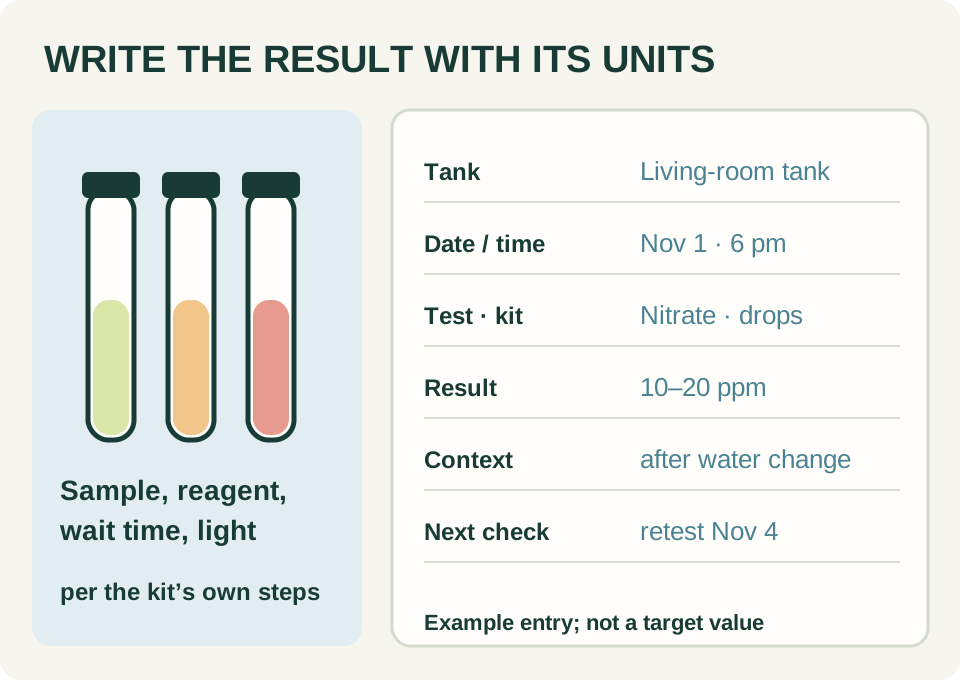
Write down the result, its units and what was happening in the aquarium. “Water fine” cannot be compared with next week's result. A useful record lets you see both the measurement and the circumstances, without pretending a color match is more precise than it really is.
How do I make a test repeatable?
Read the instructions for the specific test, not just the kit's name. API distinguishes vigorously mixing designated reagent bottles from more gently mixing capped test tubes. It also advises rinsing tubes promptly after testing. Do not assume every bottle needs identical handling or borrow another kit's sequence.2
Check expiry information and note when reagents were opened. Measure the specified sample volume and time each required wait. Use the instructed viewing arrangement and suitable light; colored aquarium lighting is not a neutral comparison setting. Contamination, incorrect quantities and reading at the wrong time can all distort the result.1
What goes in each log entry?
- Tank name; date and time; whether the sample was aquarium water or replacement water.
- Test name; kit or method; result and units exactly as displayed; any uncertainty in the color match.
- Before or after a water change; recent filter work; changes in feeding or livestock; observations of fish behavior.
- What you checked next, with the repeat result entered separately rather than overwriting the first.
For example, an entry can say “between these two chart colors” rather than inventing an extra decimal place. If you change kits, mark that change: tests can use different scale intervals, so two readings need not align perfectly. Substantial disagreement warrants checking the method rather than choosing the more reassuring number.1
What should I monitor?
Monitor ammonia, nitrite and nitrate alongside pH and temperature. Increase attention during establishment rather than treating a new tank like an established one. Testing helps assess filtration and husbandry; it is not merely a check on how clear the water looks.3
Use species-specific requirements when interpreting pH, not a universal freshwater target. API also warns that ammonia and nitrite matter even at low levels. An unexpected reading deserves prompt investigation; a tidy log is useful evidence, not permission to ignore a possible water-quality problem.2
Sources and notes 3 references
- JBL — Inaccurate water tests – or did I do something wrong after all? (opens in a new tab)October 22, 2016
- API Fishcare — Freshwater Master Test Kit, instructions and FAQs (opens in a new tab)undated
- RSPCA Australia — How should I care for my tropical fish? (opens in a new tab)Updated May 1, 2024
Background: Evergreen guide. Published November 1, 2026.
Research and reporting dates are kept as published, and older work isn’t presented as news. Product claims are attributed to their makers. Photos are illustrative and don’t show store stock.
Browse water test kits in the shop.